Seed DS-01 60-Day Refill Review: Two Sachets, 120 Capsules, and What the Label Panel Actually Breaks Down To
The 60-day refill is two 30-day sachets with no jar. We take the Supplement Facts panel apart blend by blend, trace the 72/79/67 marketing card back to the published trial numbers, and flag the refill system's one unresolved packaging question.
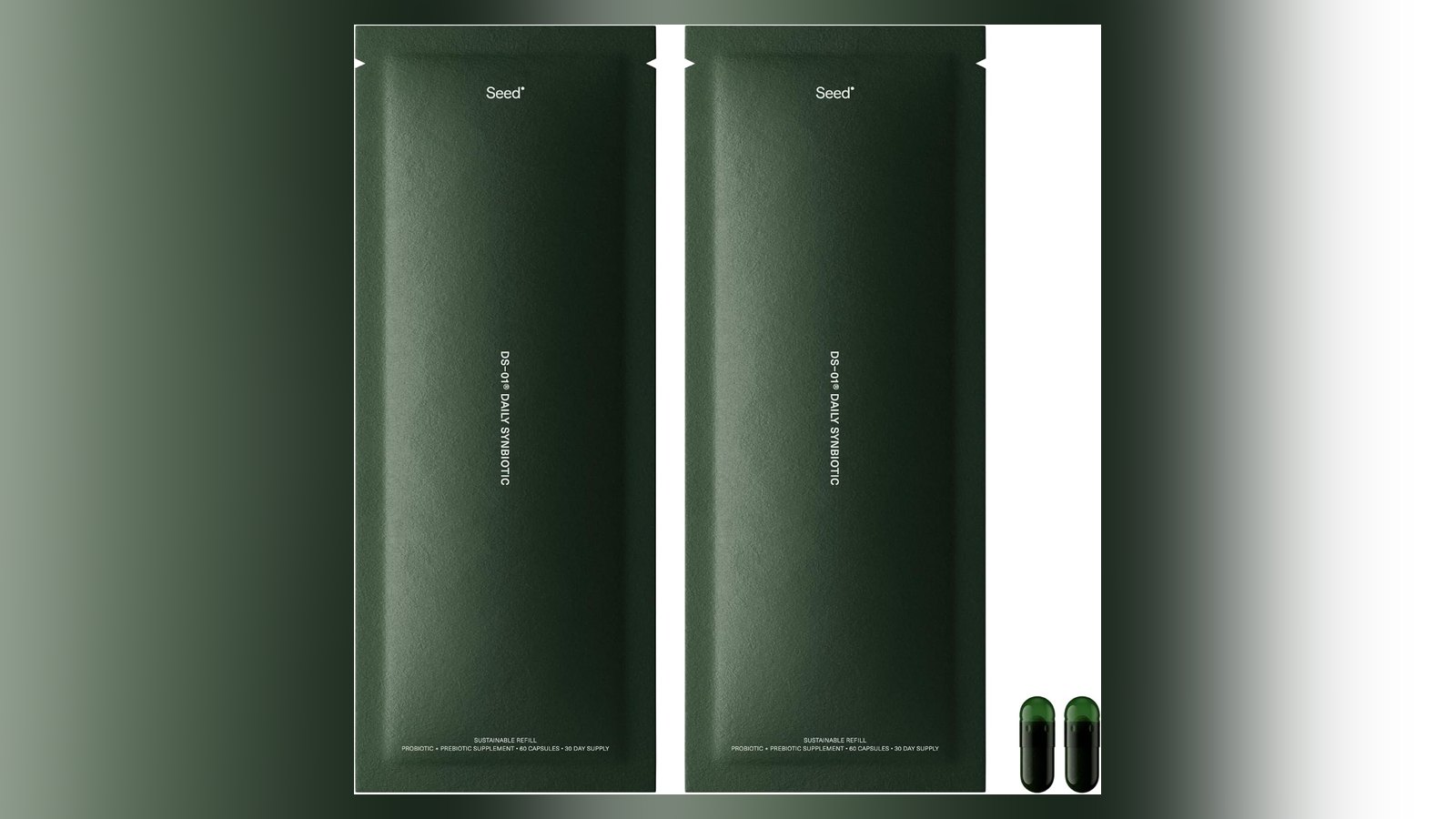
This is the format Seed is actually pushing people toward, and it is a strange one to encounter the first time. You open a box and find two sealed sachets of capsules, no jar, no bottle, no box of anything rigid. The packaging is thin foil in Seed’s deep green, and the entire point of it is that you are meant to empty it into a jar you already own.
If you do not own the jar, this listing is the wrong place to start. That is not our opinion — it is the manufacturer’s own instruction, reproduced in the listing’s feature bullets: “Begin with the 30-Day Starter to get the signature Seed jar.” The refill pack assumes the jar is already in your kitchen.
Beyond the packaging question, the DS-01 formulation does not change between these formats. Same 24 strains, same 53.6 billion AFU, same 400 mg pomegranate extract, same vegan dual-shell capsule. What changes is supply length and the physical form the capsules arrive in.
An honest note on the evidence behind this review
We did not perform hands-on testing. Nobody here has opened these sachets, poured them anywhere, or taken the capsules. This review is built from the Amazon listing record, the packaging panels and manufacturer graphics published with it, and the full text of two peer-reviewed trials of this formulation.
Two disclosures belong at the top rather than in a footnote.
The first is funding. Both trials were funded by a grant from Seed Health, Inc. The 2026 gastrointestinal trial discloses that C.V.D.E. and Z.K. are employees and shareholders of Seed, that R.J. is an employee of Increnovo LLC and an advisor to Seed, and that J.R.A. is an advisor to Seed. The 2025 microbiome trial discloses the same for B.A.N. and Z.K., with G.R. and R.J. as advisors. Both state that the sponsor had no role in trial operations and that the decision to publish was the authors’ alone. These are legitimate peer-reviewed studies of a real formulation, but they are not independent verification, and we will not describe them as such.
The second is what we can and cannot report about buyers. We could not extract individual buyer review text, so we quote no buyers and characterize no buyer consensus. The aggregate Amazon rating shown on this listing at the time of writing is 4.4 out of 5 stars from 8,546 global ratings — a platform aggregate, not our score.
What is in the pack, and what is not
- Contents: two refill sachets, 120 capsules total, 60 servings
- Serving size: 2 ViaCaps capsules
- Strains: 24 named strains across four blends
- Total per serving: 53.6 billion AFU
- Prebiotic: 400 mg MAPP (Microbiota-Accessible Polyphenolic Precursors), Indian pomegranate (Punica grananum) extract, more than 40% polyphenolic and phenolic bioactives
- Capsule: vegan — outer shell hypromellose with sodium copper chlorophyllin color, inner shell hypromellose and water, with organic rice flour and organic rice extract as carriers
- Storage: no refrigeration necessary
- Listing details: container type Sachet, 4 ounces, 10 × 9.5 × 0.5 inches, UPC 850058995267, manufacturer part number SYN-RF-AMZ-2MO
- Rating: 4.4 out of 5 stars from 8,546 global ratings (Amazon aggregate)
Note what is absent from that list: no jar. Each pouch is separately stamped “60 CAPSULES · 30 DAY SUPPLY,” so two pouches is a 60-day supply at the full two-capsule daily dose. That is the same daily dose and the same formulation as the 30-day jar, delivered in a lighter package that ships flat.
Taking the Supplement Facts panel apart
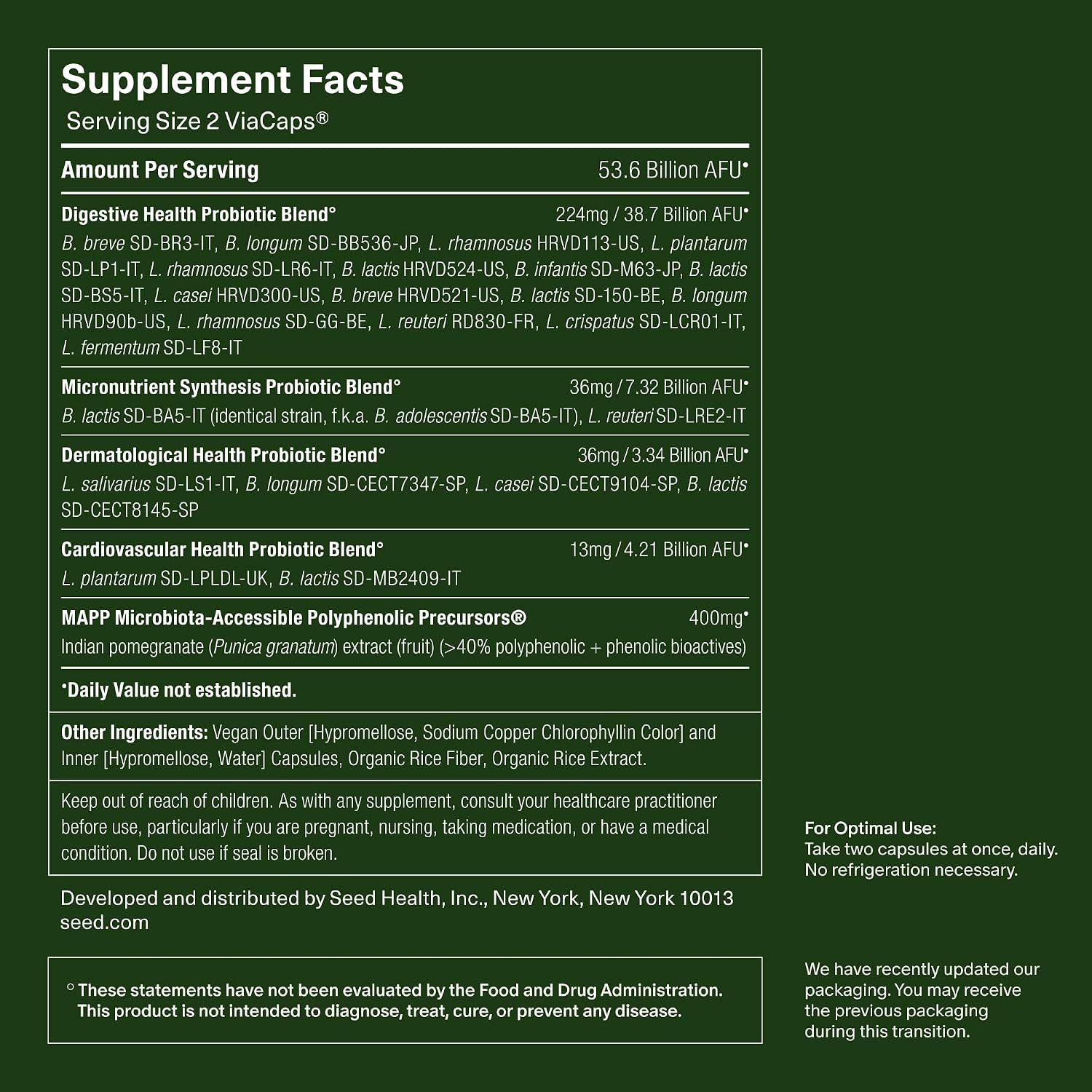
This is the most detailed probiotic label we have read for this category, and it is worth taking apart because “24 strains” on the front is much less informative than what is actually printed.
The panel states a serving size of 2 ViaCaps and 53.6 Billion AFU per serving, then breaks that total into four separate blends, each with its own weight and its own organism count:
| Blend | Strains | Amount | AFU |
|---|---|---|---|
| Digestive Health Probiotic Blend | 16 | 224 mg | 38.7 billion |
| Micronutrient Synthesis Probiotic Blend | 2 | 36 mg | 7.32 billion |
| Dermatological Health Probiotic Blend | 4 | 36 mg | 3.34 billion |
| Cardiovascular Health Probiotic Blend | 2 | 13 mg | 4.21 billion |
| Total | 24 | — | 53.6 billion |
The 38.7 billion in the digestive blend is roughly 72% of the dose, which tells you something the front of the package does not: this is overwhelmingly a digestive product, and the immune, skin and cardiovascular framing on the marketing graphics is built on the remaining 28%.
The strain codes are printed in full, down to individual deposit codes, which is unusual. The digestive blend runs from B. breve SD-BR3-IT and B. longum SD-BB536-JP through L. rhamnosus HRVD113-US, L. plantarum SD-LP1-IT, B. lactis HRVD524-US, B. infantis SD-M63-JP, L. casei HRVD300-US, B. lactis SD-150-BE, L. rhamnosus SD-GG-BE, L. reuteri RD830-FR, L. crispatus SD-LCR01-IT and L. fermentum SD-LF8-IT. The micronutrient blend is B. lactis SD-BA5-IT — the panel notes it is the identical strain formerly listed as B. adolescentis SD-BA5-IT — plus L. reuteri SD-LRE2-IT. The dermatological blend is L. salivarius SD-LS1-IT, B. longum SD-CECT7347-SP, L. casei SD-CECT9104-SP and B. lactis SD-CECT8145-SP. The cardiovascular blend is L. plantarum SD-LPLDL-UK and B. lactis SD-MB2409-IT.
Two panel notes deserve a reader’s attention. The other ingredients line names “Vegan Outer (Hypromellose, Sodium Copper Chlorophyllin Color) and Inner (Hypromellose, Water) Capsules, Organic Rice Flour, Organic Rice Extract” — so the capsule is plant-based, and the rice flour and rice extract are the carrier. And the panel states plainly that the company “recently updated our packaging” and that “You may see the previous packaging during this transition,” which is a straightforward admission that bags of this product may not all look alike.
The label’s own directions read “For Optimal Use: Take two capsules at once, daily. No refrigeration necessary.” It also carries the standard warnings: keep out of reach of children, and consult a healthcare practitioner before use if you are pregnant, nursing, taking medication, or have a medical condition.
The delivery system, and how to start
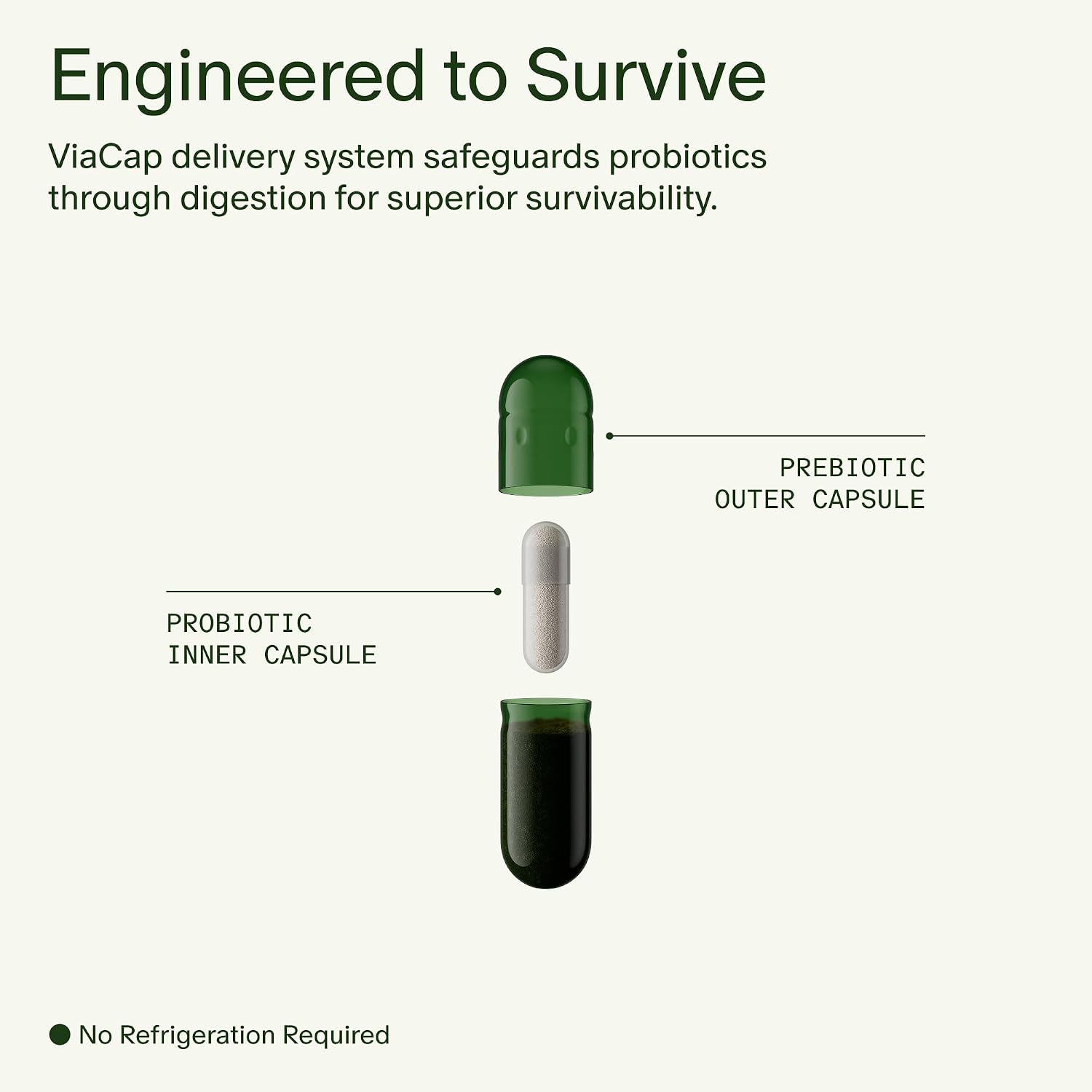
Seed describes the ViaCap system as a prebiotic outer capsule with the probiotic inner capsule inside it, and states that it “safeguards probiotics through digestion for superior survivability.” The manufacturer’s basis for that claim is an in-vitro study in a Simulator of the Human Intestinal Microbial Ecosystem — a lab model of digestion, not a measurement in people. The graphic also states “No Refrigeration Required.”
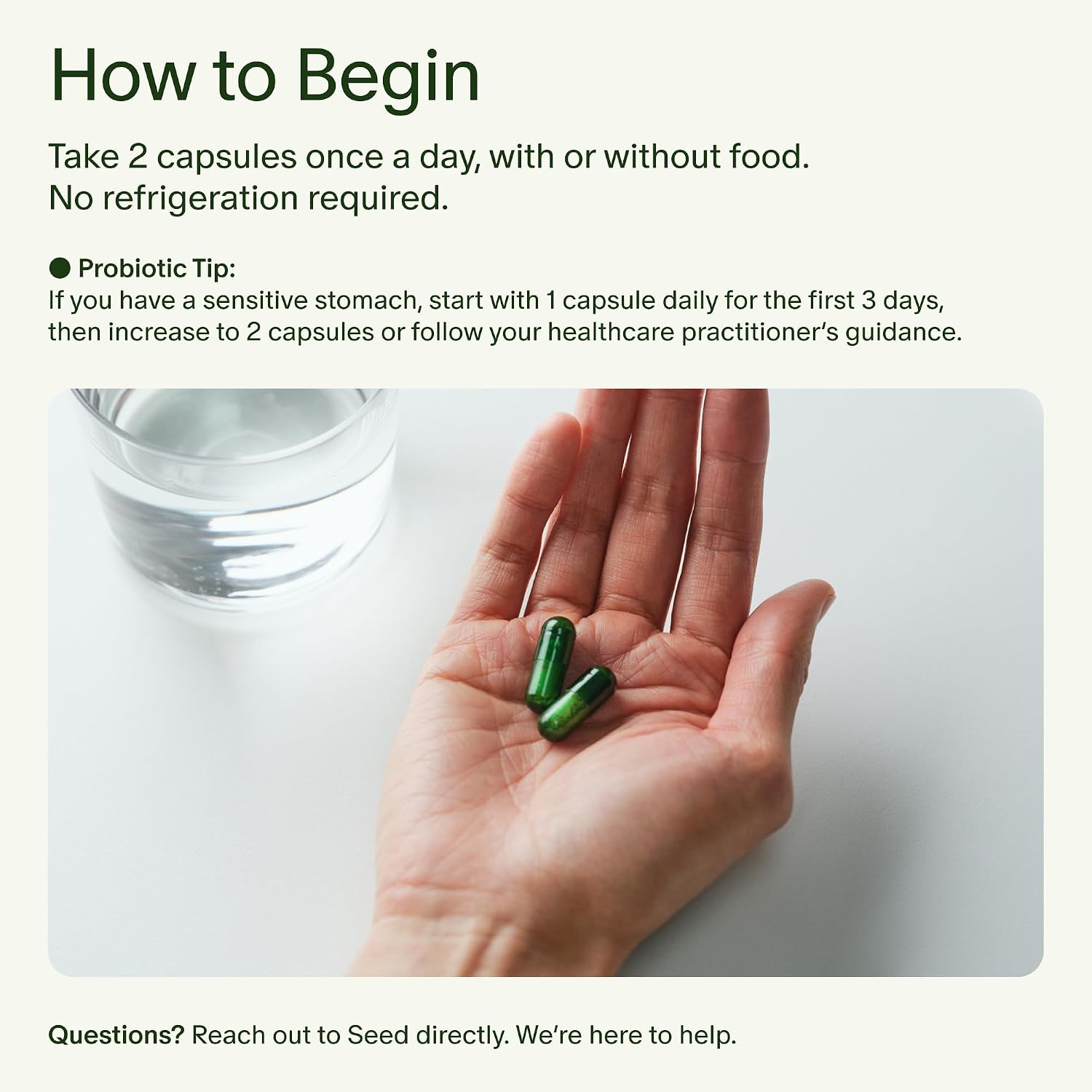
The dosing guidance is specific and worth reading before you start, because it is where a lot of people give up on probiotics unnecessarily. Two capsules once a day, with or without food. Seed’s probiotic tip is to start with one capsule daily for the first three days if you have a sensitive stomach, then increase to two, or follow your healthcare practitioner’s guidance.
That ramp is not marketing caution — it is what the trial itself did. In the 2026 study, participants took one capsule once daily for the first three days and two per day for the remainder.
Tracing the 72/79/67 card back to the trial
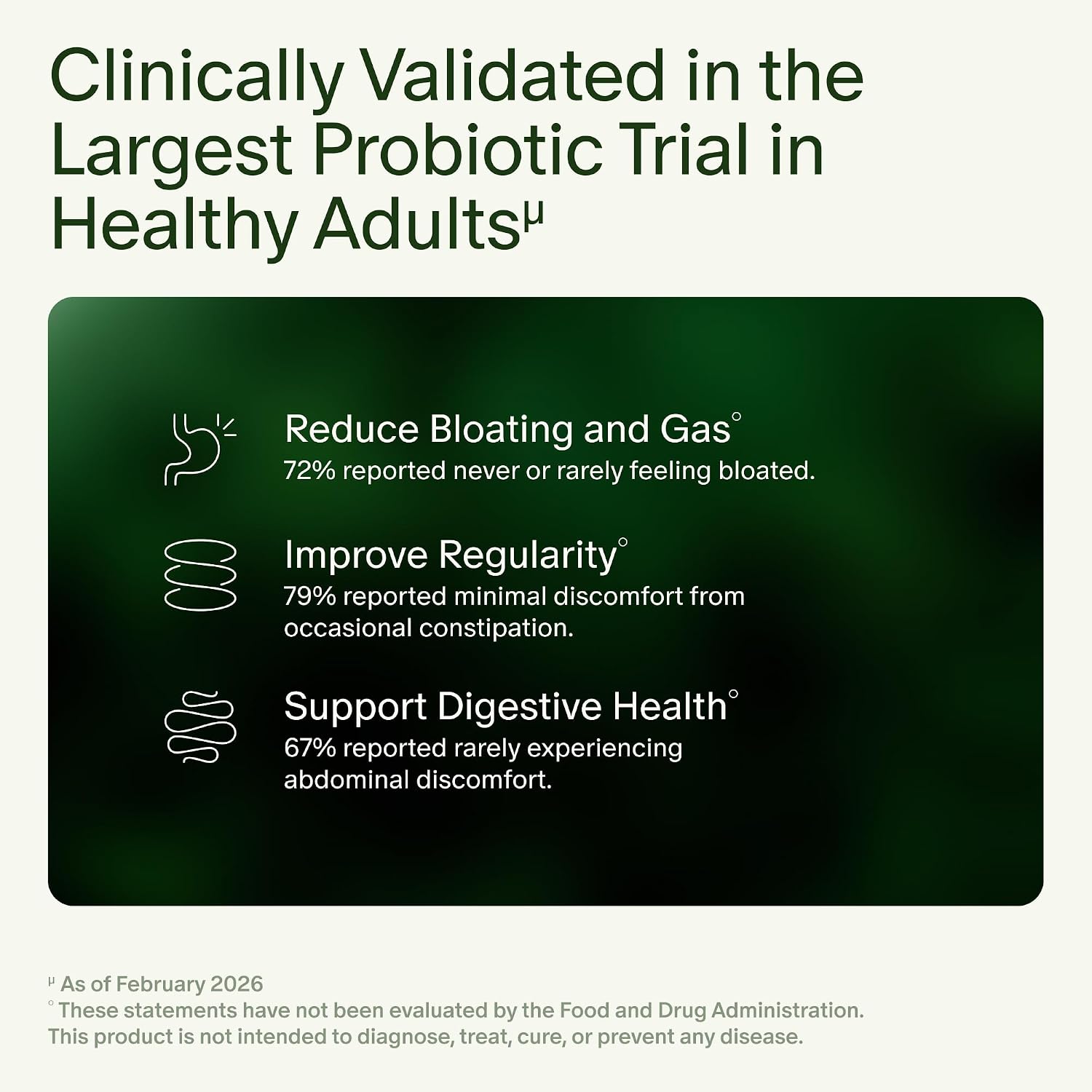
This card is the clearest example on the listing of the difference between a number and a finding, so we checked each figure against the published paper rather than repeating it.
The card reads: “Reduce Bloating and Gas — 72% reported never or rarely feeling bloated.” “Improve Regularity — 79% reported minimal discomfort from occasional constipation.” “Support Digestive Health — 67% reported rarely experiencing abdominal discomfort.” It is dated “As of February 2026” and carries the FDA disclaimer.
All three correspond to the 2026 trial, and all three match its synbiotic-arm results. The paper reports 72.3% of the synbiotic arm never or rarely experienced bloating, 79.2% rated constipation-related discomfort as none or slight, and 67.3% reported abdominal discomfort never or rarely. The card rounds each to a whole number and, importantly, drops the placebo comparison: the trial’s placebo figures were 55.9%, 71.8% and 59.3% respectively. The card’s own headline calls the source “the largest probiotic trial in healthy adults,” which is the manufacturer’s framing of a claim the paper also makes.
So the numbers are real and traceable. They are single-arm results presented without the control. That is worth knowing before you treat 72% as the expected outcome.
What the two trials measured, and who paid for them
The 2026 trial randomized 350 participants with self-reported bloating or indigestion to DS-01 or a rice-flour placebo, double-blind, for six weeks, using a decentralized design across 40 U.S. states and one territory. At Week 6 the synbiotic arm reported better gastrointestinal quality of life (0.80 vs 1.20, p < 0.05), less bloating and gas on the PROMIS-GI 13a (median 16.0 vs 21.0, p < 0.01), less abdominal discomfort on the PROMIS-GI 5a (median 8.0 vs 10.0, p < 0.01), and improved constipation and regularity measures. Safety was monitored prospectively: no serious adverse events, and no significant differences between arms (p > 0.05) in total adverse events or in symptom-specific events including dizziness, drowsiness, dry mouth, headache, insomnia, nausea, numbness/tingling and other GI symptoms.
The 2025 trial is smaller (n=32) and ran 91 days, and it measured biology rather than symptoms: increased Bifidobacterium and Lactobacillus alpha diversity at every timepoint (Day 91 p < 0.0001), urolithin A rising roughly 12-fold by Day 7 and 49-fold by Day 91, participants with urolithin-A-capable microbiomes reaching 100% versus 44.4% on placebo, increased fecal butyrate (p < 0.03), and a serum CRP change of −0.44 mg/L associated with increased B. longum and B. infantis. No participants reported adverse events in either arm.
That second study has no gastrointestinal symptom endpoints whatsoever, and its authors write that further research is needed to determine whether the biological benefit translates into clinical improvement in GI outcomes. It also used self-reported food records subject to recall bias, did not measure fecal calprotectin, and was small enough that the authors call for larger clinical-focused trials.
The refill system’s one unresolved question
The manufacturer calls this a “Sustainable Refill System” designed “to reduce shipments and packaging while saving you more on every order.” The packaging claim is easy to check and does hold up: two flat sachets ship in less material and less volume than a jar.
The workflow is clearer than it first appears. Seed’s own “Stay stocked, stay regular” graphic depicts capsules being emptied from an opened refill sachet toward the Seed jar, and the listing tells you to begin with the 30-day starter to get the jar — so the intended design is that the sachets feed the jar.
What we cannot tell you is the practical detail. Seed does not publish a step-by-step procedure for it, we did not test it, and nothing on the packaging states whether the sachets are only ever meant to be emptied into the jar or whether they are also fine to keep sealed. If the jar is a hard requirement for you, or if you want to know how the sachets are meant to be stored between uses, that is a question for the manufacturer before you order.
Pros and cons
Pros
- ✔ 24 strains split across four named blends with individual weights and AFU counts, so the dose is auditable rather than asserted
- ✔ 53.6 billion AFU per two-capsule serving, with the digestive blend carrying the large majority
- ✔ Vegan dual-shell capsule with a named 400 mg pomegranate prebiotic carrier
- ✔ Two sachets means 60 days of supply in a package that ships flat
- ✔ Two peer-reviewed trials published with full safety data and a registry number for each
Cons
- ✘ Both published trials were funded by Seed Health and include Seed employees and shareholders among the authors
- ✘ No jar is included, so this listing cannot be a first purchase
- ✘ The 72/79/67 card presents single-arm results without the placebo comparison
- ✘ The 91-day study measured microbiome and metabolites only and had no GI symptom endpoints
- ✘ Claims about skin aging, immune health and micronutrient synthesis appear on the graphics without published outcome data behind them in these trials
View the Seed DS-01 60-Day Refill on Amazon
Prices and availability change daily on Amazon — check the listing for the current offer.
Who should buy it
Buy the 60-day refill if you already own the Seed jar and want to set up a low-frequency ordering rhythm. Two pouches is 60 days, which means six purchases a year instead of twelve.
Buy it if you want the identical formula at the same daily dose in the smallest possible shipping footprint. The refill format changes nothing about what is in the capsule.
Buy it if you have looked at the Supplement Facts panel and decided the four-blend breakdown is what you wanted. This is one of the few probiotic labels where you can see exactly how much of the dose goes to digestive function versus everything else.
Who should skip it
Skip it if you do not have the jar. This listing will not get you a container, and the manufacturer tells you to start with the 30-day starter instead. Buying the refill first and the jar later means paying twice for the same capsules.
Skip it if you want an independently funded trial. For this formulation, the two published studies were both funded by Seed Health with Seed employees among the authors. We could find no unrelated-party trial.
Skip it if the marketing card is the reason you are interested. The 72/79/67 figures are real trial results, but they are the treatment arm only, and the placebo numbers in the same study were 55.9%, 71.8% and 59.3%. Judge the product on the difference, not the headline.
Frequently Asked Questions
Does the 60-day refill include the Seed jar?
No. The listing’s container type is Sachet and the pack contains two pouches of capsules. The manufacturer’s own bullet instructs buyers to “Begin with the 30-Day Starter to get the signature Seed jar,” so the jar is a separate purchase.
Is the formulation different from the 30-day jar?
No. Same product, same 24-strain four-blend structure, same 53.6 billion AFU per serving, same 400 mg pomegranate extract, same vegan ViaCaps shell. The difference is supply length and packaging format.
How many capsules are in each pouch?
Sixty. Each pouch is printed “60 CAPSULES · 30 DAY SUPPLY,” which works out to 30 servings at two capsules per serving. Two pouches give 120 capsules and 60 servings.
Do the capsules need refrigeration?
No. The label’s suggested use states it, and Seed’s delivery-system graphic repeats “No Refrigeration Required.”
Is this the product that was studied in the clinical trials?
Yes. Both published trials used a 53.6 billion AFU multi-species synbiotic with 400 mg pomegranate extract, which is the formulation on this panel.
What do 72%, 79% and 67% actually mean?
They are the synbiotic-arm figures from the 2026 trial, rounded: 72.3% never or rarely bloated, 79.2% with no or slight constipation-related discomfort, and 67.3% with abdominal discomfort never or rarely. The card omits the placebo comparison figures from the same study.
Are the capsules vegan?
Yes. The outer and inner shells are hypromellose, with sodium copper chlorophyllin color in the outer shell, and organic rice flour and organic rice extract as carriers.
The bottom line
The formulation is genuinely well specified, and the label is worth reading in full: 24 strains with deposit codes, four blends with individual weights and organism counts, 53.6 billion AFU split 38.7 / 7.32 / 3.34 / 4.21, and 400 mg of a named pomegranate extract. The 2026 trial is a large randomized double-blind placebo-controlled study with a result you can inspect, and the safety data is published rather than asserted.
What keeps us from calling it a straightforward recommendation is the combination of manufacturer-funded science presented as proof, and a marketing card that prints the treatment arm without the control. The refill packaging itself is good news — less material, less volume, same capsules — but it also means this is a second purchase, not a first one, and the jar question deserves an answer from the manufacturer before you commit.
If you already have the jar, this is the sensible way to keep it stocked. If you do not, start with the 30-day starter, and read the trial rather than the card.
Browse the Seed brand store on Amazon
Prices and availability change daily on Amazon — check the listing for the current offer.
Sources cited in this article
- Amazon — manufacturer listing for Seed DS-01 Daily Synbiotic, 60-Day Refill, including the full feature-bullet set, listing specifications, and the aggregate buyer rating of 4.4 out of 5 stars from 8,546 global ratings (accessed November 2026)
- Product packaging — the Supplement Facts panel including all four blend breakdowns and strain codes, the other-ingredients line, suggested use, warnings, manufacturer address, and the packaging-transition notice, read directly from the images published with this listing
- The manufacturer’s own product graphics published with this listing, including the delivery-system, how-to-begin and clinically validated images reproduced in this article
- Nutrients, 2026 Jan 14;18(2):255 — “A Randomized, Placebo-Controlled Trial Evaluating Multi-Species Synbiotic Supplementation for Bloating, Gas, and Abdominal Discomfort” (PMID 41599868), full text read via PMC12845427
- Nutrients, 2025 Aug 23;17(17):2734 — “Multi-Species Synbiotic Supplementation Enhances Gut Microbial Diversity, Increases Urolithin A and Butyrate Production, and Reduces Inflammation in Healthy Adults” (PMID 40944126), full text read via PMC12430871
- ClinicalTrials.gov registrations NCT06009614 and NCT04171466, as cited in the respective trial publications
This article contains affiliate links. When you buy through them, we may receive a commission from the brand or platform at no additional cost to you. Our editorial process is independent of affiliate relationships — see our Affiliate Disclosure and Our Method.