Seed DS-01 30-Day Refill Review: One Sachet, 30 Servings, and What the Packaging's Own Timeline Does Not Prove
The 30-day refill is a single sachet of 60 capsules meant to top up a jar you already own. We walk through the refill workflow, hold the packaging's four benefit milestones against what the two published trials actually measured, and check Seed's third-party testing claims.
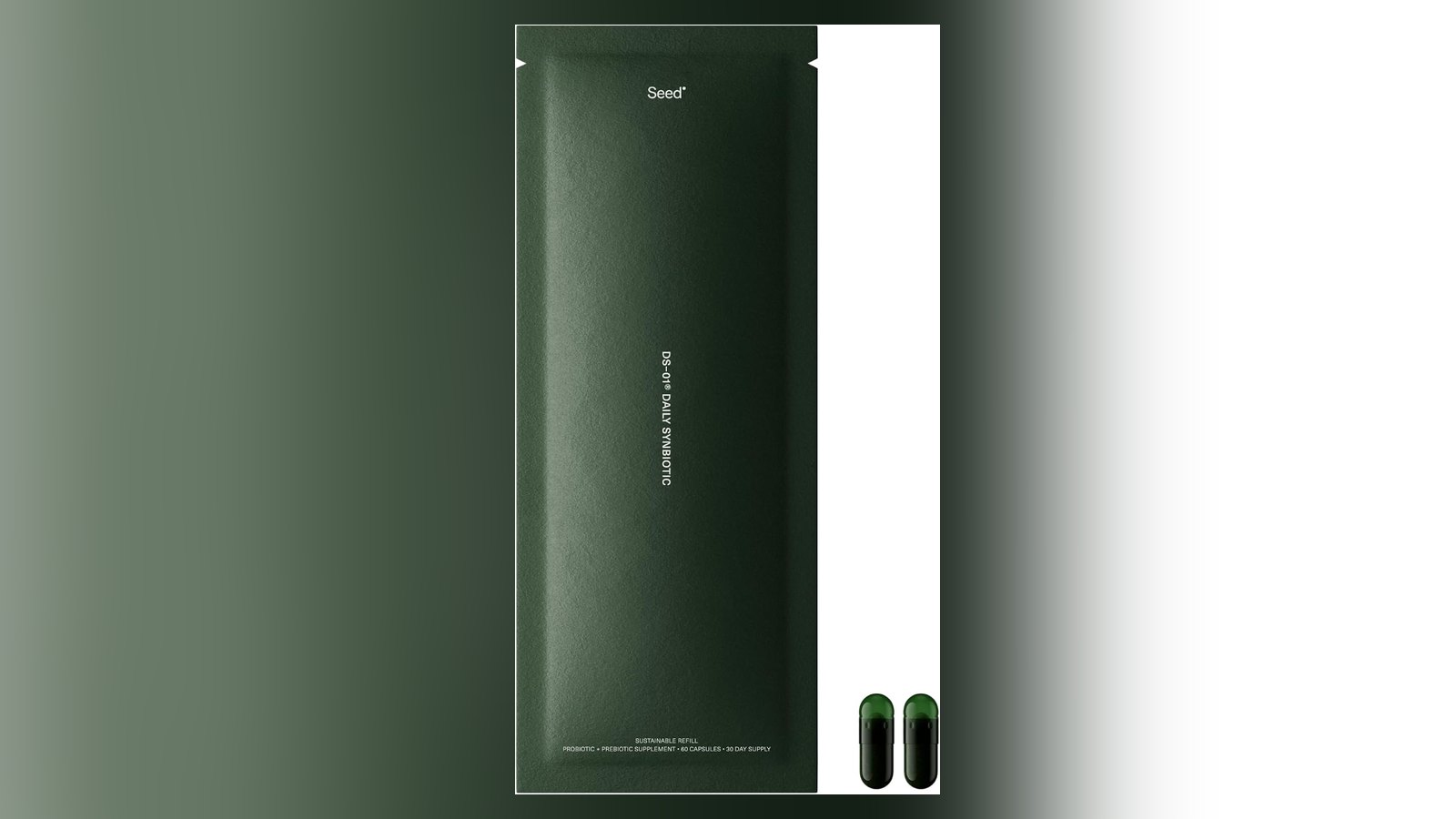
This is the format for people who have already made the decision. One flat sachet, 60 capsules, 30 servings, no jar in the box. The pouch is printed “SUSTAINABLE REFILL” and “PROBIOTIC + PREBIOTIC SUPPLEMENT • 60 CAPSULES,” and the manufacturer’s instruction is that you begin with the 30-day starter to get the jar, then refill it from these.
What makes this format worth a separate look is what the packaging claims about time. The refill sachets ship with a graphic that lays out benefits at four moments — 7 days, 2 weeks, 4 weeks, 3 months. Two peer-reviewed trials exist for this formulation, and their measurement points do not line up with that timeline in the way you would expect. That is the subject of this review.
An honest note on the evidence behind this review
We did not perform hands-on testing. Nobody here has opened this sachet, tipped capsules into a jar, or taken them. Everything here comes from the Amazon listing record, the packaging panels and manufacturer graphics published with it, and the full text of two peer-reviewed trials.
Both trials were funded by a grant from Seed Health, Inc. The 2026 gastrointestinal trial discloses that C.V.D.E. and Z.K. are employees and shareholders of Seed, that R.J. is an employee of Increnovo LLC and an advisor to Seed, and that J.R.A. is an advisor to Seed. The 2025 microbiome trial discloses the same for B.A.N. and Z.K., with G.R. and R.J. as advisors. Both state that the sponsor had no role in trial operations and that publication was the authors’ decision alone. We are not going to call this independent validation, because it is not.
We could not extract individual buyer review text, so we quote no buyers. The aggregate Amazon rating shown on this listing at the time of writing is 4.4 out of 5 stars from 8,546 global ratings — a platform aggregate of buyer submissions, not our editorial score.
What is in the sachet
- Contents: one refill sachet, 60 capsules, 30 servings
- Serving size: 2 ViaCaps capsules
- Strains: 24 named strains across four blends
- Total per serving: 53.6 billion AFU
- Prebiotic: 400 mg MAPP (Microbiota-Accessible Polyphenolic Precursors), Indian pomegranate (Punica grananum) extract, more than 40% polyphenolic and phenolic bioactives
- Capsule: vegan — outer shell hypromellose with sodium copper chlorophyllin color, inner shell hypromellose and water, with organic rice flour and organic rice extract as carriers
- Storage: no refrigeration necessary
- Listing details: container type Sachet, 60 capsules, 30 servings, 9.88 × 4.04 × 0.6 inches, UPC 850058995250, manufacturer part number SYN-RF-AMZ
- Rating: 4.4 out of 5 stars from 8,546 global ratings (Amazon aggregate)
This is the same formulation as the jar and the 60-day refill: same 24 strains, same 53.6 billion AFU per serving, same 400 mg pomegranate extract, same vegan dual-shell capsule. Only the supply length and the physical package differ.
The refill workflow, in the manufacturer’s own picture
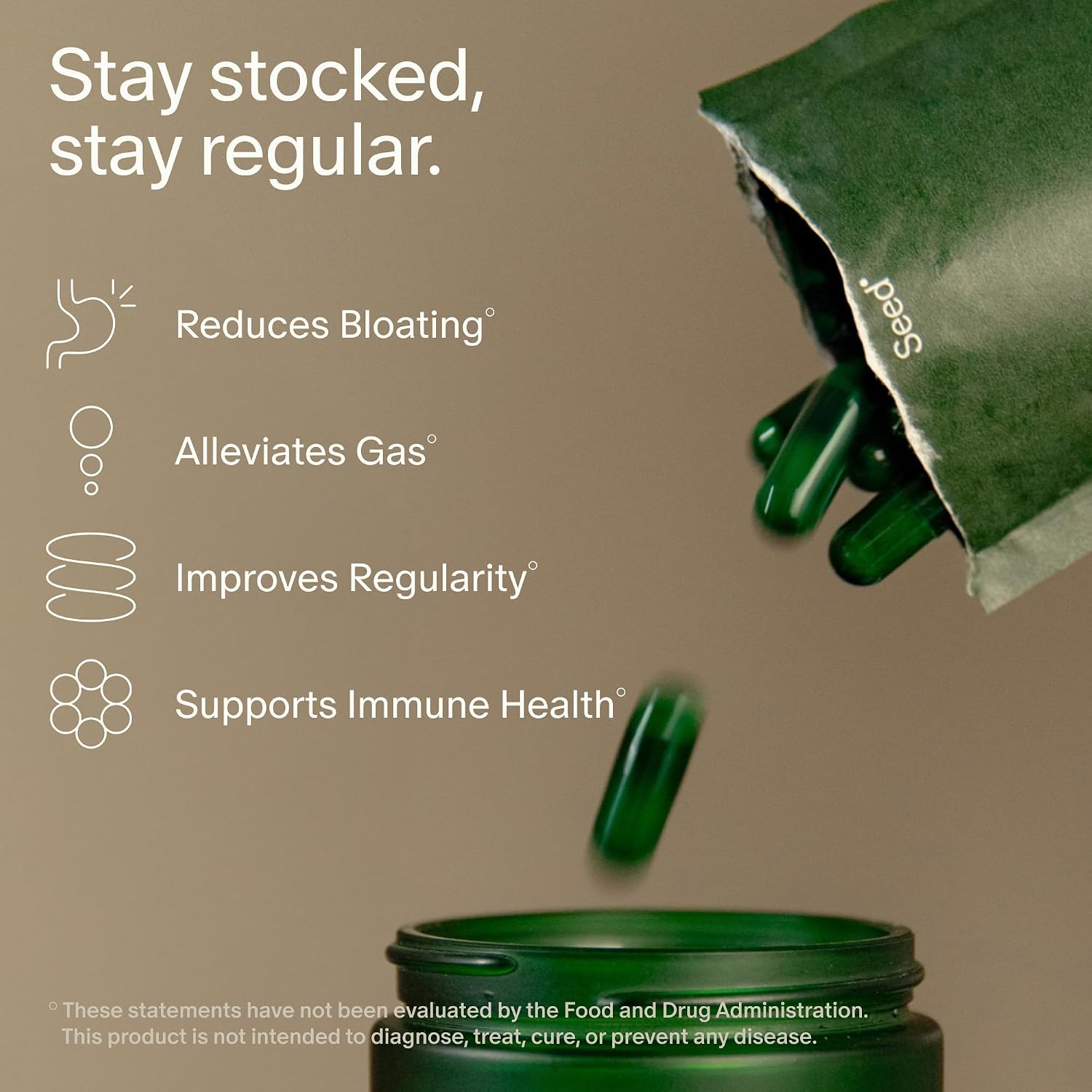
This graphic settles the question that the 60-day listing leaves open. It shows an opened sachet tipping green capsules downward toward the rim of the Seed jar, with the jar sitting underneath. So the intended use is: tear the pouch, pour the capsules into the jar you already own, and repeat every month.
The same graphic lists four claims — Reduces Bloating, Alleviates Gas, Improves Regularity, Supports Immune Health — each carrying a superscript that ties back to the FDA disclaimer stating these statements have not been evaluated by the Food and Drug Administration and that the product is not intended to diagnose, treat, cure or prevent any disease. Three of those four map onto what the 2026 trial measured. “Supports Immune Health” does not: neither trial had an immune endpoint.
We did not test this workflow, and Seed still does not publish a written procedure for it. But the intended design is now unambiguous from the packaging.
The timeline claim, and where it lines up with the evidence
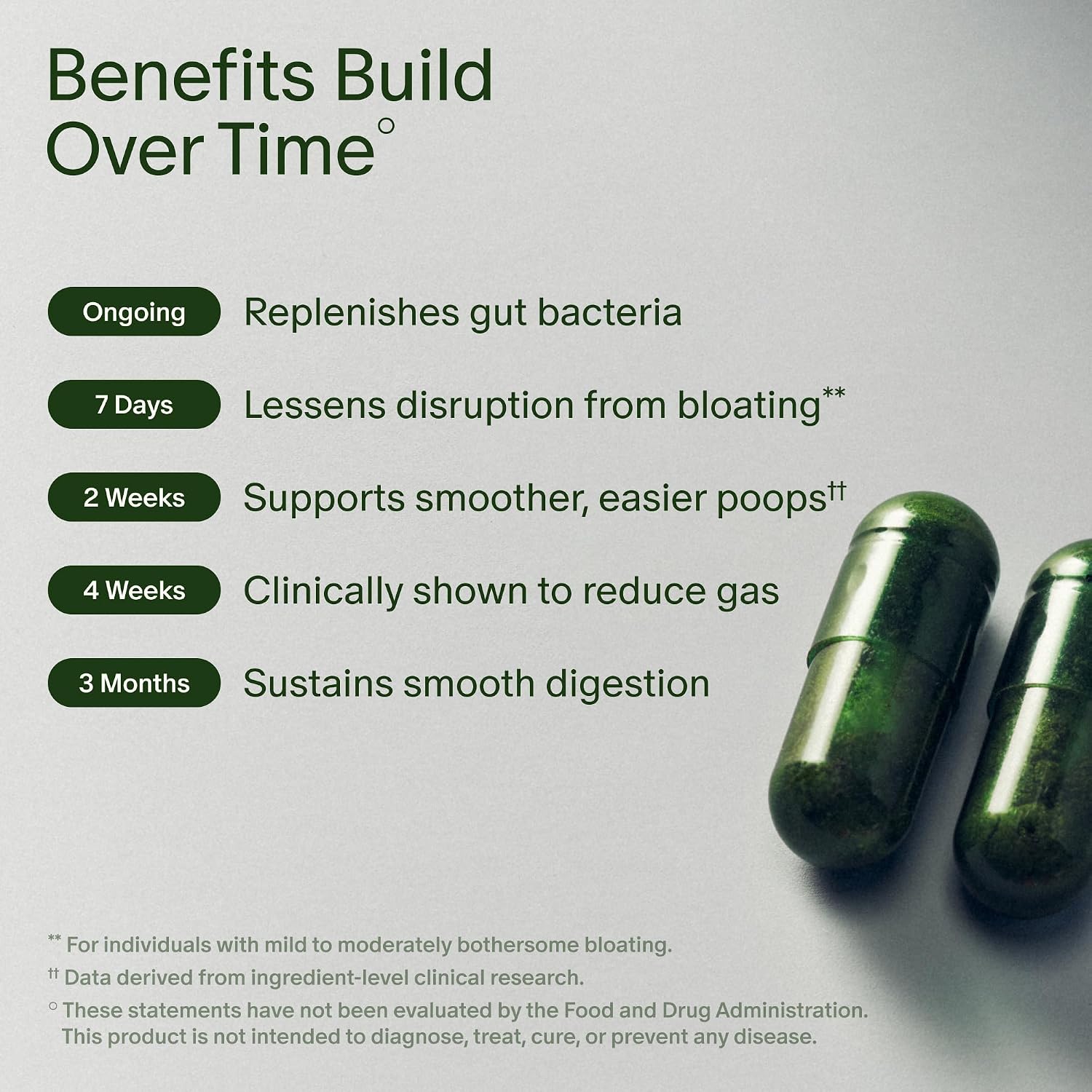
This is the most interesting claim set on the listing, and it is the reason we wanted to write about this particular format. The graphic lays out five lines:
- Ongoing — Replenishes gut bacteria
- 7 Days — Lessens disruption from bloating**
- 2 Weeks — Supports smoother, easier poops‡‡
- 4 Weeks — Clinically shown to reduce gas
- 3 Months — Sustains smooth digestion
And it prints a footnote legend underneath:
”** For individuals with mild to moderately bothersome bloating.” ”‡‡ Data derived from ingredient-level clinical research.” ”° These statements have not been evaluated by the Food and Drug Administration. This product is not intended to diagnose, treat, cure, or prevent any disease.”
So the packaging itself already qualifies two of its five lines. The seven-day bloating line is restricted to people who have mild to moderately bothersome bloating. The two-week regularity line is explicitly not based on a study of this product — the legend says the data is derived from ingredient-level clinical research. And the four-week gas line carries no footnote marker at all.
Now set those milestones against the two published studies for this formulation.
The 2026 symptom trial ran six weeks, and it measured its endpoints at Week 6. There was no four-week reading of gas in the results we read. The paper’s gas and bloating outcome is the PROMIS-GI 13a score at Week 6, where the synbiotic arm reported median 16.0 versus 21.0 for placebo (p < 0.01), and 72.3% versus 55.9% never or rarely experiencing bloating (p < 0.001). The paper also reports the improvement “from baseline” figures of 54.3% versus 42.5% for bloating and gas, but the comparison point is still Week 6.
The three-month line has a different problem, and it is the more interesting one. The 91-day study is the only trial that runs to roughly three months, and it is also the only one whose length matches the claim. But that trial measured biology, not symptoms: Bifidobacterium and Lactobacillus alpha diversity, urolithin A production, fecal butyrate, and serum CRP. It had no gastrointestinal symptom endpoints at all, and its authors state plainly that further research is needed to determine whether the biological benefit demonstrated in that study leads to clinical improvements in GI outcomes.
That is the gap. “3 Months — Sustains smooth digestion” reads as a symptom outcome, and the one trial covering that length measured the microbiome instead. The authors of that trial themselves draw the line the packaging blurs.
None of this means the product fails to work. The 2026 trial is a genuine, large, randomized, double-blind, placebo-controlled result with a symptom benefit at six weeks. It means the packaging’s milestone markers should be read as marketing framing rather than as a trial readout, and the one line the packaging explicitly labels as ingredient-level research is a genuine candidate for scrutiny.
What the two trials actually found
The 2026 trial randomized 350 participants with self-reported bloating or indigestion to DS-01 or a rice-flour placebo, double-blind, for six weeks, with a decentralized design across 40 U.S. states and one U.S. territory. At Week 6 the synbiotic arm reported better gastrointestinal quality of life on the DQLQ (0.80 vs 1.20, p < 0.05), less bloating and gas on the PROMIS-GI 13a (median 16.0 vs 21.0, p < 0.01), less abdominal discomfort on the PROMIS-GI 5a (median 8.0 vs 10.0, p < 0.01), and improved constipation and regularity measures. Safety was monitored prospectively, with no serious adverse events reported and no significant differences between arms (p > 0.05) in total adverse events or in symptom-specific events including dizziness, drowsiness, dry mouth, headache, insomnia, nausea, numbness/tingling and other GI symptoms.
The 2025 trial ran 91 days with 32 healthy adults and measured microbiome diversity (Day 91 p < 0.0001 for Bifidobacterium and Lactobacillus alpha diversity), urolithin A rising roughly 12-fold by Day 7 and 49-fold by Day 91, urolithin-A-capable microbiomes at 100% versus 44.4% on placebo, increased fecal butyrate (p < 0.03), and a serum CRP change of −0.44 mg/L associated with increased B. longum and B. infantis. HbA1c fell in the synbiotic arm but stayed within the normal range expected for a healthy population without metabolic syndrome. No participants reported adverse events in either arm.
Its limitations are the ones that matter for the timeline claim: small and mechanistic-focused, self-reported food records subject to recall bias and underreporting, no fecal calprotectin measurement, and healthy adults only.
The testing and delivery claims
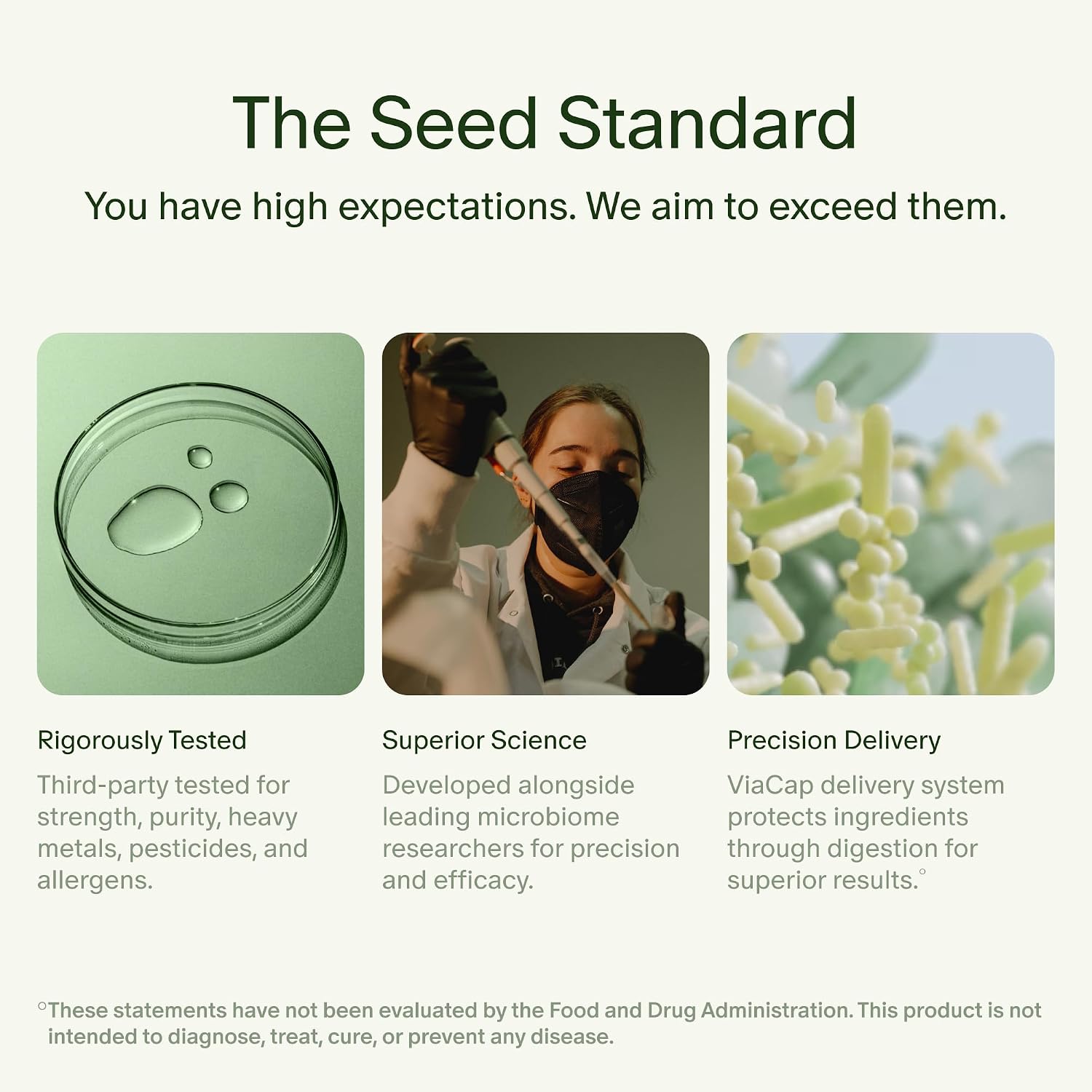
This graphic states three things. “Rigorously Tested — Third-party tested for strength, purity, heavy metals, pesticides, and allergens.” “Superior Science — Developed alongside leading microbiome researchers for precision and efficacy.” “Precision Delivery — ViaCap delivery system protects ingredients through digestion for superior results.” The third one restates the capsule-in-capsule design that appears on the other Seed listings, with the manufacturer stating its basis as an in-vitro study in a Simulator of the Human Intestinal Microbial Ecosystem — a lab digestion model, not a measurement in people.
The third-party testing claim is worth reading carefully as well. It names the categories tested — strength, purity, heavy metals, pesticides, allergens — but the graphic does not name a testing laboratory, a certification program, or a standard. If third-party verification is one of your criteria, that is a question for Seed directly rather than something the packaging answers.
Pros and cons
Pros
- ✔ The smallest packaging format in the range — one flat sachet that ships in a slim mailer
- ✔ 60 capsules at two per serving, a clean monthly cycle
- ✔ The refill-into-the-jar workflow is shown unambiguously in the manufacturer’s own graphic
- ✔ No refrigeration required, so the sachet can be stored at room temperature
- ✔ The packaging qualifies its own claims, including flagging one line as ingredient-level research
Cons
- ✘ Both published trials were funded by Seed Health and include Seed employees and shareholders among the authors
- ✘ The 7-day, 2-week and 4-week milestones on the packaging do not correspond to any measurement point in the published symptom trial, which read out at Week 6
- ✘ The 3-month claim sits closest to the 91-day trial, and that trial had no symptom endpoints — its authors say the clinical link is still unproven
- ✘ The 2-week regularity line is stated on the packaging as ingredient-level research, not product-level data
- ✘ The third-party testing claim names no laboratory, program or standard
- ✘ No jar is included, so this cannot be a first purchase
View the Seed DS-01 30-Day Refill on Amazon
Prices and availability change daily on Amazon — check the listing for the current offer.
Who should buy it
Buy it if you already have the Seed jar and want the smallest possible package to keep it stocked. One sachet is one month, and it ships flat in a slim mailer.
Buy it if you would rather read the packaging’s claims with the footnotes attached. This listing is the one that prints them — the individual-bloating qualifier, the ingredient-level note, and the FDA disclaimer — and that transparency is unusual enough to be worth something on its own.
Buy it if you want the identical DS-01 formulation on a monthly cycle and have decided the capsule-in-capsule design suits you.
Who should skip it
Skip it if you do not own the jar. The listing’s manufacturer instruction is to begin with the 30-day starter to get it, and buying the refill first means paying for the same capsules twice.
Skip it if you are buying on the strength of a timeline. “7 Days,” “2 Weeks,” “4 Weeks” and “3 Months” are marketing milestones, and none of them lines up cleanly with a measurement point in the published trials. If those markers are what convinced you, we would rather you read the Week 6 results instead.
Skip it if third-party verification in the strict sense is a requirement. The packaging asserts the categories tested but names no laboratory or standard, and we could not verify one from the listing.
And skip it if you want the 91-day study to tell you the product improves digestion. It does not say that, and its authors go out of their way to say it has not been shown yet.
Frequently Asked Questions
Does this include the Seed jar?
No. The listing’s container type is Sachet and the pack is one pouch of 60 capsules. The manufacturer’s own feature bullet says to begin with the 30-Day Starter to get the signature Seed jar, so the jar is a separate purchase.
How many capsules are in the pouch, and how long do they last?
Sixty capsules. At two ViaCaps per serving that is 30 servings, and the pouch is printed “60 CAPSULES” with the listing recording 30 servings — one month at the full daily dose.
Is the formula the same as the jar version?
Yes. Same 24-strain four-blend structure, same 53.6 billion AFU per serving, same 400 mg pomegranate extract, same vegan dual-shell capsule. Only the packaging and supply length differ.
What do the timeline footnotes on the packaging actually say?
Three things. The seven-day bloating line is qualified “For individuals with mild to moderately bothersome bloating.” The two-week regularity line is qualified “Data derived from ingredient-level clinical research.” And the whole graphic carries the FDA disclaimer that the statements have not been evaluated by the Food and Drug Administration and that the product is not intended to diagnose, treat, cure or prevent any disease.
Did the clinical trial show results at four weeks?
Not in the results we read. The 2026 trial measured its endpoints at Week 6. It does report improvement-from-baseline percentages, but the between-arm comparison is a Week 6 comparison.
What did the 91-day trial find?
Microbiome diversity, urolithin A and butyrate production, and a reduction in serum CRP, all in 32 healthy adults. It had no gastrointestinal symptom endpoints, and the authors state that whether those biological changes translate into clinical GI improvement still needs to be determined.
Does it need refrigeration?
No. The label’s suggested use states it, and the delivery-system graphic on Seed’s other listings repeats “No Refrigeration Required.”
Are the capsules vegan?
Yes. Outer and inner shells are hypromellose, with sodium copper chlorophyllin color in the outer shell, and organic rice flour and organic rice extract as carriers.
The bottom line
The refill sachet is the least interesting object and the most revealing packaging in this range. The capsule is the same one in every format, and the label is as detailed as we have seen. What the sachet adds is the manufacturer’s timeline graphic, and that graphic is where the marketing and the published science part company: the symptom trial read out at Week 6, the microbiome trial ran 91 days without measuring symptoms at all, and the packaging’s own footnotes concede that one of its milestones comes from ingredient-level research rather than from a study of this product.
That does not make the product bad. The six-week result is real and worth reading in the paper rather than in a card. It makes the timeline a place to be careful. The sachet itself is well made, ships flat, needs no refrigeration, and its refill workflow is shown clearly enough that you will not need the instructions.
Buy it to keep a jar you already own stocked. Read the Week 6 results before you count on a day-seven result.
Browse the Seed brand store on Amazon
Prices and availability change daily on Amazon — check the listing for the current offer.
Sources cited in this article
- Amazon — manufacturer listing for Seed DS-01 Daily Synbiotic, 30-Day Refill, including the full feature-bullet set, listing specifications, and the aggregate buyer rating of 4.4 out of 5 stars from 8,546 global ratings (accessed November 2026)
- Product packaging — the Supplement Facts panel, other-ingredients line, suggested use and storage statement, manufacturer address, and the packaging-transition notice, read directly from the images published with this listing
- The manufacturer’s own product graphics published with this listing, including the refill-workflow, benefits-timeline and Seed Standard images reproduced in this article
- Nutrients, 2026 Jan 14;18(2):255 — “A Randomized, Placebo-Controlled Trial Evaluating Multi-Species Synbiotic Supplementation for Bloating, Gas, and Abdominal Discomfort” (PMID 41599868), full text read via PMC12845427
- Nutrients, 2025 Aug 23;17(17):2734 — “Multi-Species Synbiotic Supplementation Enhances Gut Microbial Diversity, Increases Urolithin A and Butyrate Production, and Reduces Inflammation in Healthy Adults” (PMID 40944126), full text read via PMC12430871
- ClinicalTrials.gov registrations NCT06009614 and NCT04171466, as cited in the respective trial publications
This article contains affiliate links. When you buy through them, we may receive a commission from the brand or platform at no additional cost to you. Our editorial process is independent of affiliate relationships — see our Affiliate Disclosure and Our Method.