Grownsy EaseClean Bottle Washer Review: 4-in-1 Cleaning, 212°F Steam and a 19-Minute Quick Wash
The Grownsy EaseClean washes, sterilizes, dries and stores bottles in one countertop housing: 26 spray jets at 24,000 Pa, four programs across nine cleaning modes, 212°F steam and 72 hours of filtered storage. We check the claims against CDC infant-feeding hygiene guidance and the published contamination research.
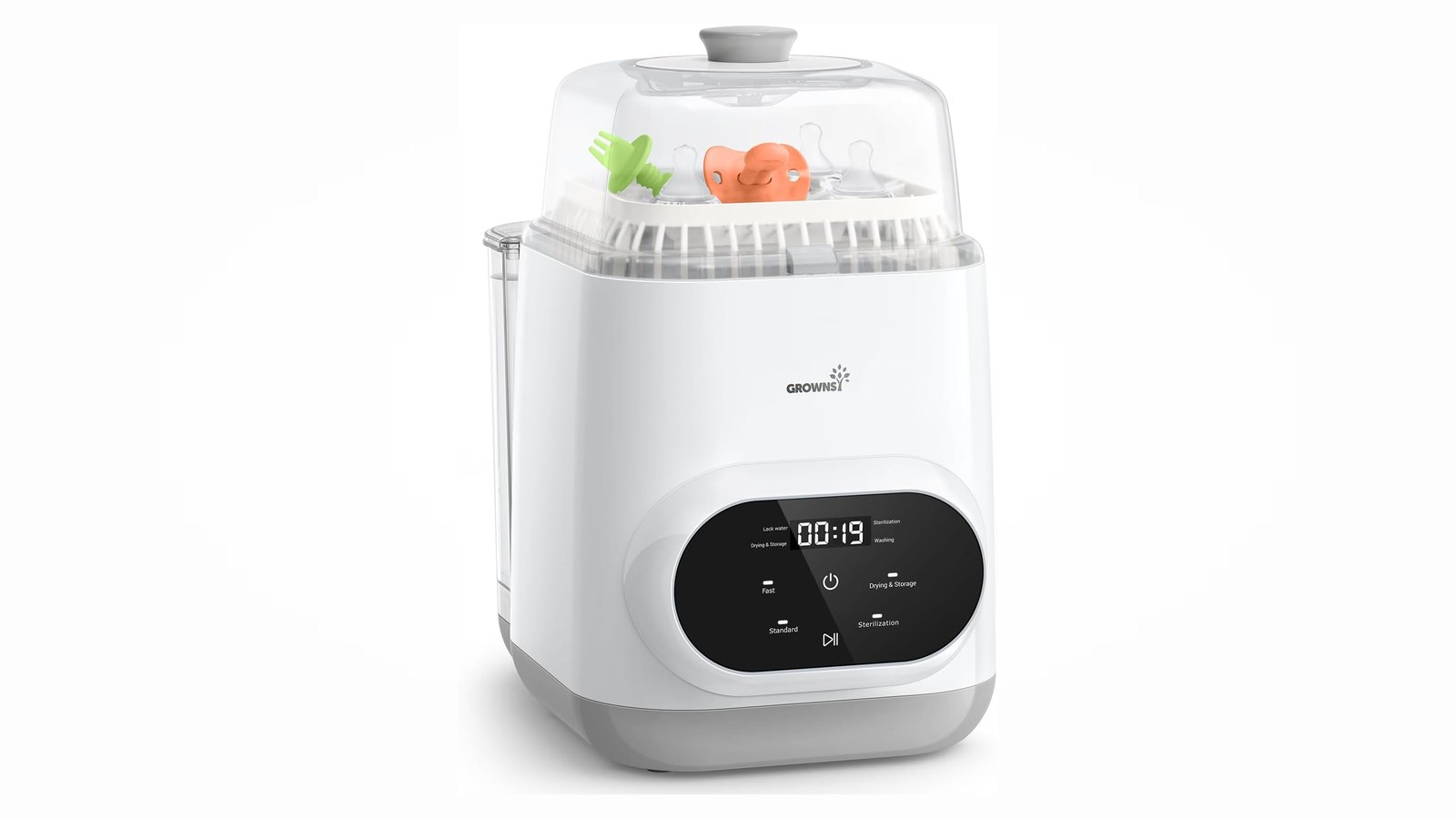
Bottle washing is the least glamorous job in a house with a newborn, and it is the one that has to be repeated several times a day for months. The Grownsy EaseClean belongs to a growing class of countertop machine that tries to take the scrubbing out of it: this one washes, sterilizes, dries and stores bottles, pump parts, pacifiers and sippy cups inside a single housing with a transparent dome on top.
This is a single-product review. It is based on the manufacturer’s published specifications, the aggregated verified-buyer ratings on the listing, and the clinical and public-health research on infant-feeding-item hygiene. We did not perform hands-on testing of this product. Our full method is on the Our Method page, and every source we relied on is listed at the bottom.
One note on how this listing relates to the EaseClean Pro we review separately: the two are sold from the same parent listing on Amazon, so they share a single rating pool of 4.5 stars from 1,579 ratings, and the buyer’s feedback you read on one is the buyer’s feedback on both. The Pro listing adds features — visible windows, a self-cleaning cycle, descaling tablets, a night-light mode and a one-hand refill tank — that this listing does not mention. Amazon’s own copy on this page flags that a newer version is available, which is consistent with the Pro being the later specification. The same copy also calls this machine “Bottle Washer Pro” in its feature bullets — “The Bottle Washer Pro is equipped with 12 precision-directed sprays” — which is one of the reasons the two listings are hard to tell apart from the outside.
What the EaseClean actually is
- Type: Countertop baby bottle washer, sterilizer, dryer and storage cabinet
- Colour: White — the variation this listing opens on, and the one shown in the images below
- Item model number: ZMW-STHB01-3
- Size and weight: 9.84 x 13.39 x 16.14 inches, 11 lb
- Functions: Wash, steam-sterilize, hot-air dry, and store
- Programs: 4 — Quick Wash, Standard Wash, Sterilize, and Dry & Storage
- Cleaning modes: 9 in total across those four programs
- Fastest cycle: Quick Wash, claimed at 19 minutes for bottles and pacifiers
- Water delivery: 26 jets — 12 precision-directed interior sprays plus 14 swirling jets for 360° exterior cleaning
- Pressure: Manufacturer rating of 24,000 Pa on the high-pressure water system
- Water use: Claimed to use 86% less water than traditional manual washing
- Sterilizing: 212°F high-temperature steam, claimed to kill 99.99% of germs
- Drying: Hot-air drying after the steam stage
- Storage: Built-in HEPA filter, claimed to remove 99.9% of airborne particles, with a claimed 72-hour sterile-storage window
- Capacity: 4–8 bottles plus pump parts, pacifiers and sippy cups on a double-layer basket
- Power: 120V, 60Hz, designed for North American power
- In the box: The machine, 60 Grownsy detergent tablets, and a 3-year warranty
- Rating: 4.5 out of 5 stars from 1,579 aggregated Amazon ratings
- Our score: 8.0/10
Two things about those numbers need context before anything else.
First, the 4.5-star rating is not this listing’s alone. Because the EaseClean and the EaseClean Pro sit under the same parent product on Amazon, both draw on the same 1,579-rating pool. If you have read buyer feedback on one of them, you have read it on both.
Second, every headline figure above — 99.99% germ reduction, 99.9% particle removal, 24,000 Pa, the 86% water saving — is a manufacturer claim rather than an independently reproduced result. We treat them as claims throughout this review.
The routine it replaces
The pitch behind countertop washers is straightforward and, on the evidence, largely sound: the manual method for cleaning feeding equipment is a basin of hot soapy water, a dedicated brush, thorough rinsing and air drying, repeated after every feeding. It works, but it is a fixed daily tax, and it is a tax paid at 2am.
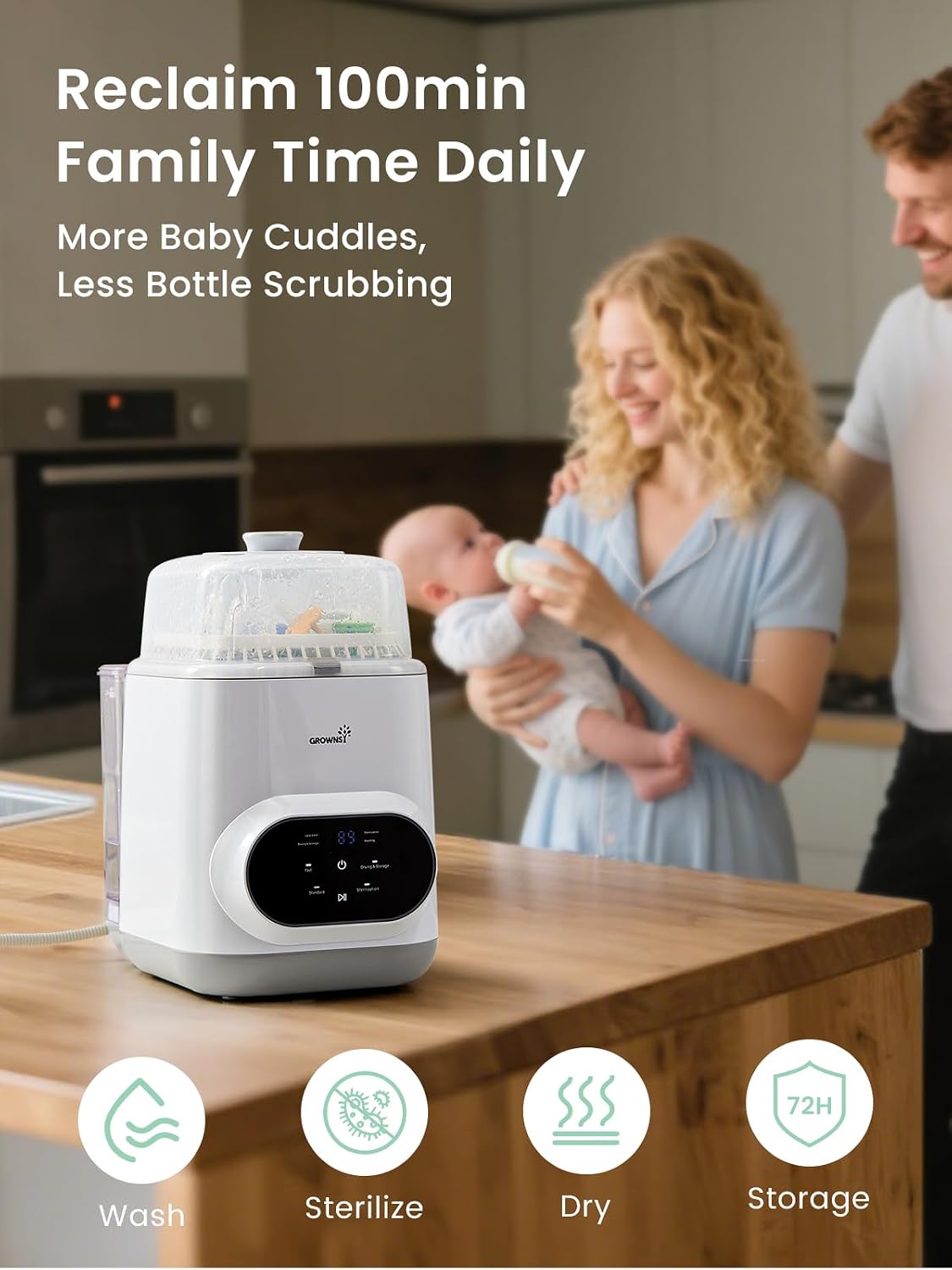
The counter-argument, which the CDC makes explicitly, is that this manual scrub is not decorative. Scrubbing with soap and a brush is the step that removes the milk film that builds up on feeding equipment and harbours bacteria. Any machine that claims to replace that step has to demonstrate that its jets and detergent do the same work, and no independent test of this machine has been published. What the machine does unambiguously remove is the number of times a person has to do it: one button press replaces a basin, a brush, a rinse and a drying rack, and the dirty items get loaded within hours of use rather than sitting until evening.
The four programs map onto that routine cleanly. Quick Wash is the short cycle for a couple of bottles. Standard Wash is the default. Sterilize is a dedicated steam run. Dry & Storage is the closing cycle that leaves the load sealed and filtered for later use. Nine modes across four programs is more granularity than most households need, but it does mean the load can be matched to the day rather than the day matched to the load.
26 jets, 24,000 Pa, and where the water saving comes from
The mechanical claim is the most concrete part of the specification. Twelve precision-directed sprays are aimed into bottle interiors and nipples, and fourteen swirling jets run around the outside of the load for full 360° coverage — which matters, because milk residue on threads and collars is exactly what stays wet when a bottle is only rinsed by hand.
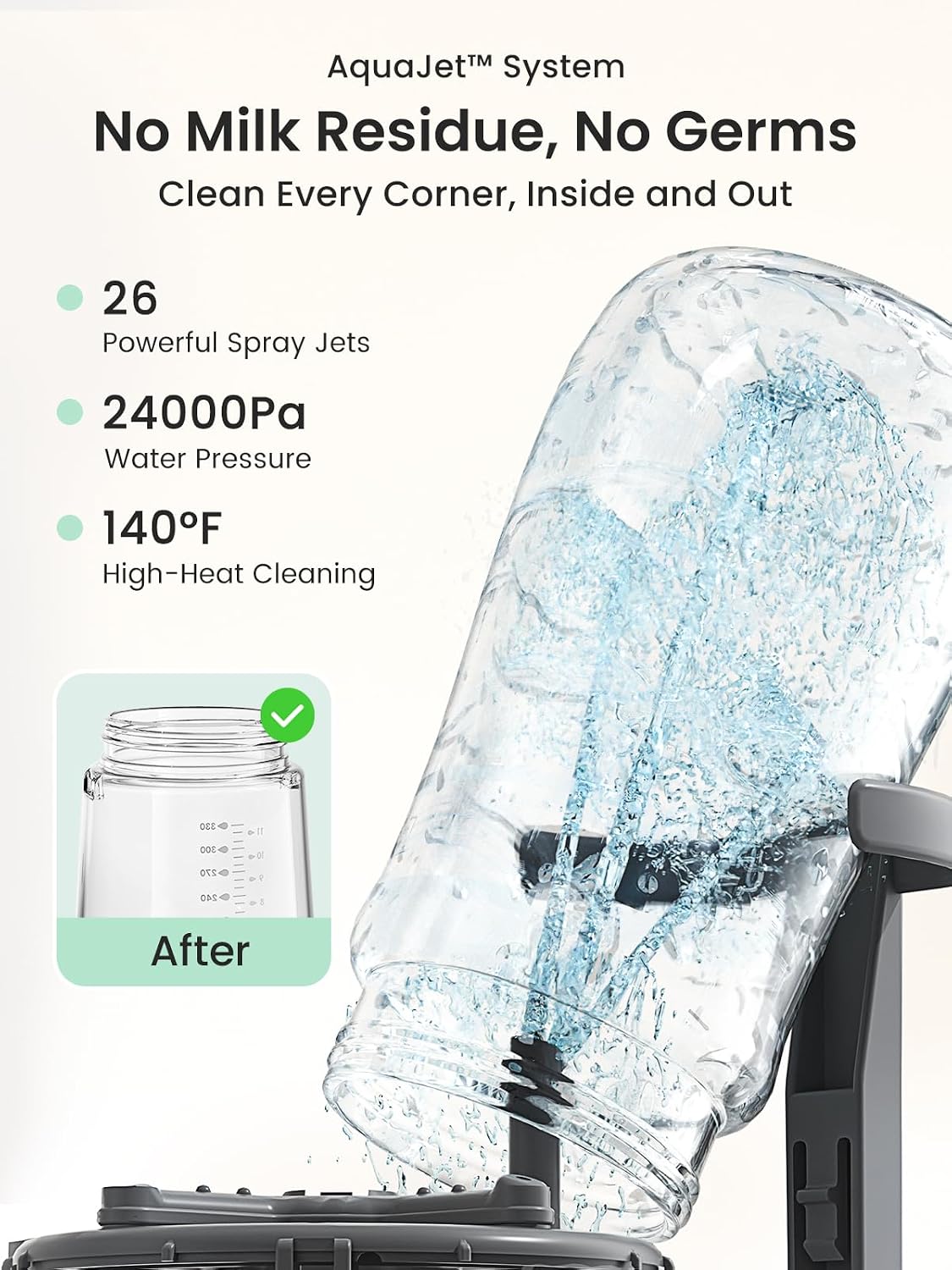
The wash stage is advertised as 140°F high-heat cleaning driven through that jet array at up to 24,000 Pa — a figure taken from the AquaJet graphic above rather than from the written copy, which names 212°F for the steam stage and gives no wash temperature in words. The two numbers describe different steps of the same cycle, and only the graphic carries the lower one. The listing also claims the machine uses 86% less water than hand washing, which is not implausible for a fixed-volume system that fills and drains once per cycle rather than running under a tap — but note that the baseline it is measured against, “traditional manual washing,” is the most water-intensive version of the task, and the machine still has to fill, rinse and drain the same water as any other washing device.
212°F steam, hot-air drying and the 72-hour storage claim
This is where the machine’s hygiene argument rests, and it is the claim most worth taking seriously, because it maps onto a real recommendation.
Sterilizing with steam at 212°F (100°C) is a long-established and well-understood method. The CDC’s own guidance notes that a dishwasher run with hot water and a heated drying cycle can kill more germs, and that a separate sanitizing step is then unnecessary. The logic of a dedicated 212°F steam stage sits comfortably inside that framework: water vapour at 100°C is a genuine thermal condition, and it is the same physics as steam in a pressure cooker, at ambient rather than pressurised pressure.
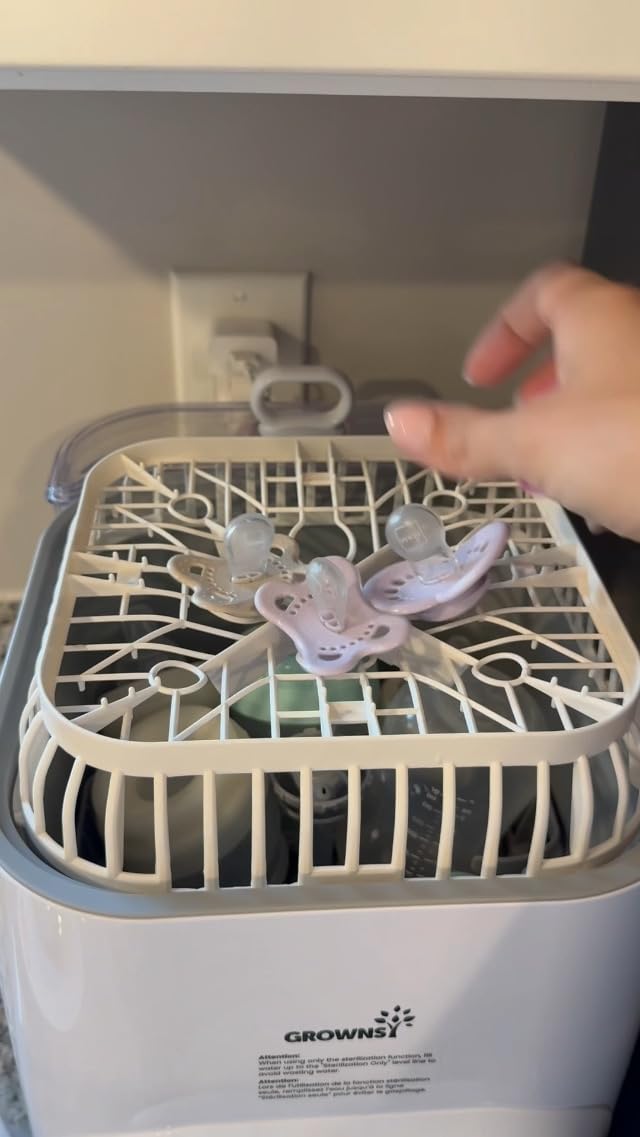
Hot-air drying matters more than it looks. Wet equipment in a closed basket is a warm, enclosed, wet environment, and the CDC’s guidance is explicit that items should be allowed to air-dry thoroughly and that a towel should not be used to rub or pat them dry, because that transfers germs. A dedicated heated-dry stage inside a filtered cabinet is a cleaner version of that advice than a dish rack.
The 72-hour storage claim is the weakest of the three. “Sterile for up to 72 hours” is a bounded claim, not an open-ended one — after that window the listing makes no promise. The HEPA filtration figure of 99.9% airborne-particle removal is doing real work here, because the plausible failure mode of storing washed bottles for days is airborne contamination of an open basket rather than residual liquid.
What the hygiene research actually supports
We looked for independent evidence on the two things this machine promises: that feeding equipment is contaminated at the levels people assume, and that streamlined washing reduces that contamination.
Feeding equipment is genuinely contaminated in ordinary households. A study of peri-urban households in Lima, Peru found faecal bacteria in 43.8% of sampled baby bottles and on 21.7% of caregiver hands. That is not a marginal finding about one dirty sink; it is the ordinary state of bottle hygiene in a setting where handwashing rates are low. The same study found that a package of hygiene measures which included brushing bottles improved bottle and hand contamination, and brushing was a named part of the intervention rather than an optional extra.
Rinsing alone is not enough. A 2026 systematic review of cleaning methods for child feeding equipment found that rinsing with water alone was consistently ineffective at reducing contamination, that washing with soap combined with brushing performed better, and that chlorine-based disinfection substantially reduced contamination, with the effect depending on concentration and contact time. The review’s conclusion is that both the mechanical action of scrubbing and the correct chemical and thermal conditions matter.
Documented outbreaks are usually equipment-mediated. An MMWR report on two infant Cronobacter infections in the United States in 2021 and 2022 traced one to opened powdered infant formula that had been contaminated, and one to breast-pump equipment. The CDC’s guidance reflects that experience: clean bottles after every feeding, sanitize them daily for extra germ removal or if your baby is under two months old, was born premature, or has a weakened immune system, and wash your hands before handling cleaned items.
Read against that research, the honest summary is this. The machine’s heating, drying and storage stages address conditions that the CDC’s guidance says matter — thorough cleaning, effective sanitizing, and complete drying. Its washing stage replaces the manual brush with jets and detergent, which is a plausible engineering answer to the same problem but one with no published independent verification for this specific product. And its 99.99% figure is a manufacturer claim about a defined protocol, not a guarantee for a load assembled by one person at 2am.
None of that makes the machine a bad purchase. It makes it an unverified one, in a category where the alternative — a basin, a brush and discipline — is free and has three decades of public-health guidance behind it.
Capacity: 4–8 bottles, and what that means on a normal day
The double-layer basket is sized for 4 to 8 bottles, which is a genuinely useful range. A household with one bottle-fed baby and one bottle-pumping parent is cleaning perhaps four to six items per day, plus pump parts after every session. A machine that washed one bottle at a time would not be worth the counter space; one that takes a full load at once starts paying for itself immediately.
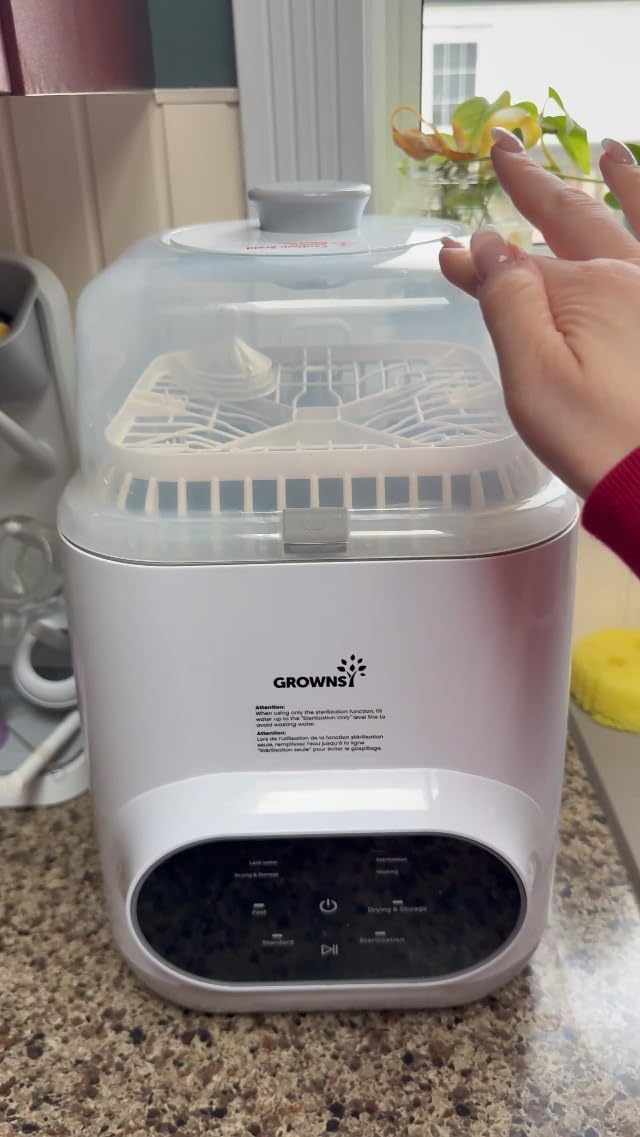
Two practical notes on capacity. The listed dimensions are 9.84 x 13.39 x 16.14 inches, which is a substantial object to keep permanently on a counter, and it needs clearance above the lid to lift the dome. And the storage window only helps if the basket stays dry — a load left wet in the machine overnight is a load held warm and enclosed, which is the opposite of what the drying cycle is for.
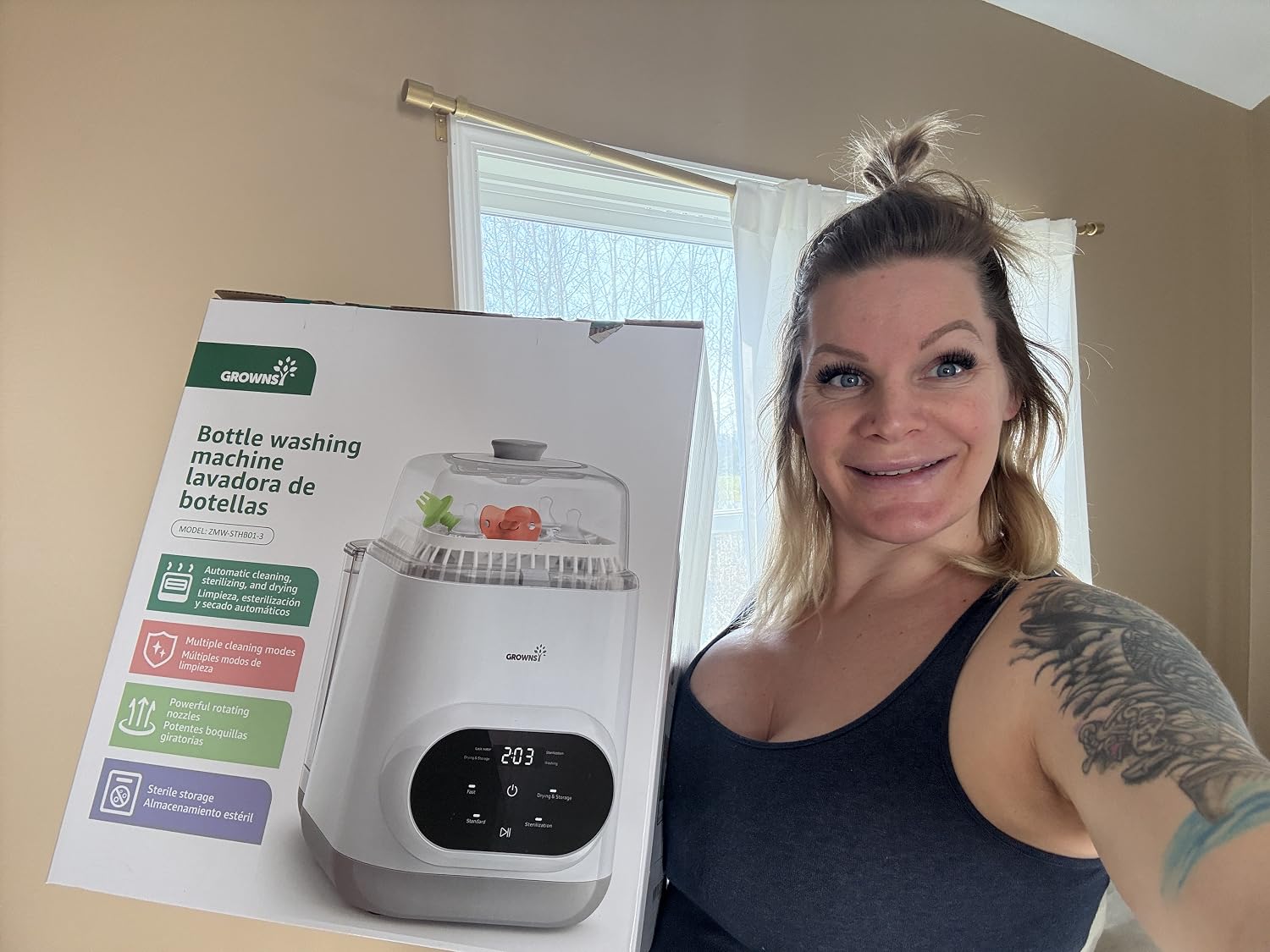
Sixty detergent tablets are included, which is roughly two months of daily use for a typical household and removes the awkward question of whether the machine needs anything proprietary at all. The 3-year warranty is longer than the 1-year term that is common on small kitchen appliances, and it covers the parts most likely to be exposed to heat and water.
Pros and cons
Pros
- ✔ Covers the whole routine — wash, sterilize, dry, store — in one countertop appliance
- ✔ 26 jets with 12 aimed interior sprays, plus a stated 24,000 Pa working pressure
- ✔ 212°F steam sterilizing and a dedicated hot-air drying stage
- ✔ HEPA-filtered storage with a stated 72-hour window
- ✔ Handles 4–8 bottles and pump parts in a single load
- ✔ 60 detergent tablets and a 3-year warranty included
- ✔ Backed by a large 1,579-rating buyer pool, shared with the EaseClean Pro listing rather than counted twice
Cons
- ✘ The listing does not document transparent viewing windows, so watching a cycle in progress is not a stated feature
- ✘ No dedicated self-cleaning cycle for the machine itself, and no descaling tablets in the box
- ✘ 11 lb and 16 inches tall is a permanent commitment of counter space
- ✘ Every headline number, including the 99.99% figure, is a manufacturer claim
- ✘ It does not remove the need to load items promptly and let the basket dry between cycles
- ✘ Shares its rating pool with the EaseClean Pro, so the two listings are not independent samples
Who should buy it
Buy the EaseClean if bottle washing is the daily task you most want to stop doing by hand, and if your household is doing enough volume per day that a load-at-once machine makes sense. It is the plainest version of the idea, and plainness is a genuine advantage when you are paying for a device that will live on a counter for two years.
Buy it if you are comfortable with the trade this product asks for: one button press and a closed lid in exchange for accepting that the scrubbing is now done by jets and detergent rather than by your hands and a brush.
Who should skip it
Skip it if you do not yet have a routine that justifies a machine of this size. For a handful of bottles a day, a sink basin, a bottle brush and a drying rack does the same job for nothing, and the CDC’s manual method is the one with the clearest evidence behind it.
Skip it if you want to see inside the cycle. The EaseClean listing documents no transparent viewing windows; you start a load and find out at the end. If reassurance during the cycle is the point of the purchase, the EaseClean Pro is the version built around that.
Skip it if you are in a hard-water area and do not want to think about descaling. This listing includes no descaling tablets and no self-cleaning mode, so scale management falls back on you.
Frequently Asked Questions
Does the Grownsy EaseClean really kill 99.99% of germs?
That figure is the manufacturer’s claim for its 212°F steam cycle under a defined protocol. It is not an independently verified result for this machine, and no independent laboratory test of the EaseClean has been published that we could find. The underlying method — steam at 100°C — is well established; the specific number on the listing is a claim.
Is a bottle washer safer than washing by hand?
There is no published evidence showing that countertop bottle washers outperform the CDC’s manual method in a typical household. The CDC’s guidance still centres on washing with soap and a brush, rinsing, and air-drying thoroughly. What a machine reliably removes is the repetition, and the risk that comes with a 2am job done half-heartedly — a real, if hard to quantify, benefit.
How long do cleaned bottles stay sterile?
Up to 72 hours according to the listing, which is the point of the HEPA-filtered storage cabinet. Treat that as a bounded window rather than an open-ended one, and only if the load was fully dried and the lid stayed closed.
Can it clean breast pump parts and pacifiers?
Yes. The listing states it handles pump parts from both wearable and traditional pumps, along with pacifiers and sippy cups, and the double-layer basket is designed for exactly that mix. The steam stage is also what makes sanitizing pump parts practical, since they are the component most often implicated in contamination.
Does it work with any brand of bottle?
The listing states it fits bottles of all brands and sizes, and it names specific models as compatible. We have not verified fitment for every brand and every part geometry ourselves.
Should I buy the EaseClean or the EaseClean Pro?
They are the same machine sold under two listings, and they share one rating pool. Choose the EaseClean if you want the simpler version and the smaller feature set. Choose the EaseClean Pro if you want transparent windows, a self-cleaning cycle, descaling tablets, a night-light mode and a one-hand refill tank. We review the Pro separately.
View the Grownsy EaseClean on Amazon
Prices and availability change daily on Amazon — check the listing for the current offer.
Browse the full GROWNSY range on Amazon
The GROWNSY store page groups the brand's range by category — bottle washers, baby food makers, warmers and sterilizers among them — so you can see what else GROWNSY sells.
The bottom line
The Grownsy EaseClean does what it says on the tin at the level of engineering: a 26-jet wash stage, a genuine 212°F steam steriliser, a hot-air dryer and a HEPA-filtered storage cabinet that keeps a load sealed for up to three days. For a household running several bottles and pump parts a day, replacing a 2am basin-and-brush routine with a button press is a real quality-of-life change, and the 60 included tablets and 3-year warranty make it a low-ceremony purchase.
What it does not do is prove itself. No independent laboratory evaluation of this machine exists that we could find, the 99.99% and 99.9% figures are manufacturer claims, and the manual method it replaces is the one public-health guidance actually documents. The honest way to buy it is as a well-specified convenience appliance with a credible mechanism, not as a verified steriliser.
View the Grownsy EaseClean on Amazon
Prices and availability change daily on Amazon — check the listing for the current offer.
Sources cited in this article
- Centers for Disease Control and Prevention — “How to Clean, Sanitize, and Store Infant Feeding Items,” archived copy of the CDC WASH guidance page (clean bottles after every feeding; sanitize daily for extra germ removal or for babies under 2 months, premature infants, or infants with weakened immune systems; wash with soap and a brush, rinse, and air-dry without rubbing with a towel; a dishwasher with hot water and a heated drying cycle can make a separate sanitizing step unnecessary)
- Haque R, Nurunnahar S, Islam MS, Sayeed T, Habib A, Salje H, Winch PJ, Dreibelbis R. “Cleaning Methods and Microbial Safety of Child Feeding Equipment: A Systematic Review.” Maternal & Child Nutrition, 2026;22(3):e70207 — water-only rinsing consistently ineffective; soap plus brushing performed better; chlorine-based disinfection substantially reduced contamination, with effects depending on concentration and contact time
- Rothstein JD, Mendoza AL, Cabrera LZ, Pachas J, Calderon M, Pajuelo MJ, Caulfield LE, Winch PJ, Gilman RH. “Household Contamination of Baby Bottles and Opportunities to Improve Bottle Hygiene in Peri-Urban Lima, Peru.” The American Journal of Tropical Medicine and Hygiene, 2019;100(4):988-997 — faecal bacteria detected in 43.8% of sampled bottles and 21.7% of caregiver hands; brushing was a named part of an improved hygiene intervention
- Haston JC, Miko S, Cope JR, et al. “Cronobacter sakazakii Infections in Two Infants Linked to Powdered Infant Formula and Breast Pump Equipment — United States, 2021 and 2022.” MMWR Morbidity and Mortality Weekly Report, 2023;72(9):223-226 — two infant infections traced to contaminated opened powdered formula and to breast-pump equipment
- Amazon — manufacturer listing for the Grownsy EaseClean (B0D7ZS8NG3), including published specifications, the AquaJet system graphic, the aggregated 4.5-star rating from 1,579 ratings, and the note that this listing and the EaseClean Pro listing share one parent product and therefore one rating pool (accessed November 2026)
This article contains affiliate links. When you buy through them, we may receive a commission from the brand or platform at no additional cost to you. Our editorial process is independent of affiliate relationships — see our Affiliate Disclosure and Our Method.