GOLDENMATE 1000VA/800W Lithium UPS Review: 230Wh and Pure Sine Wave, With No USB Charging
The GOLDENMATE 1000VA/800W tower combines a 230Wh lithium iron phosphate battery, pure sine wave output and eight protected outlets. We read its listing specification rows against its own product graphics, and the two disagree on battery cycle life and unit weight.
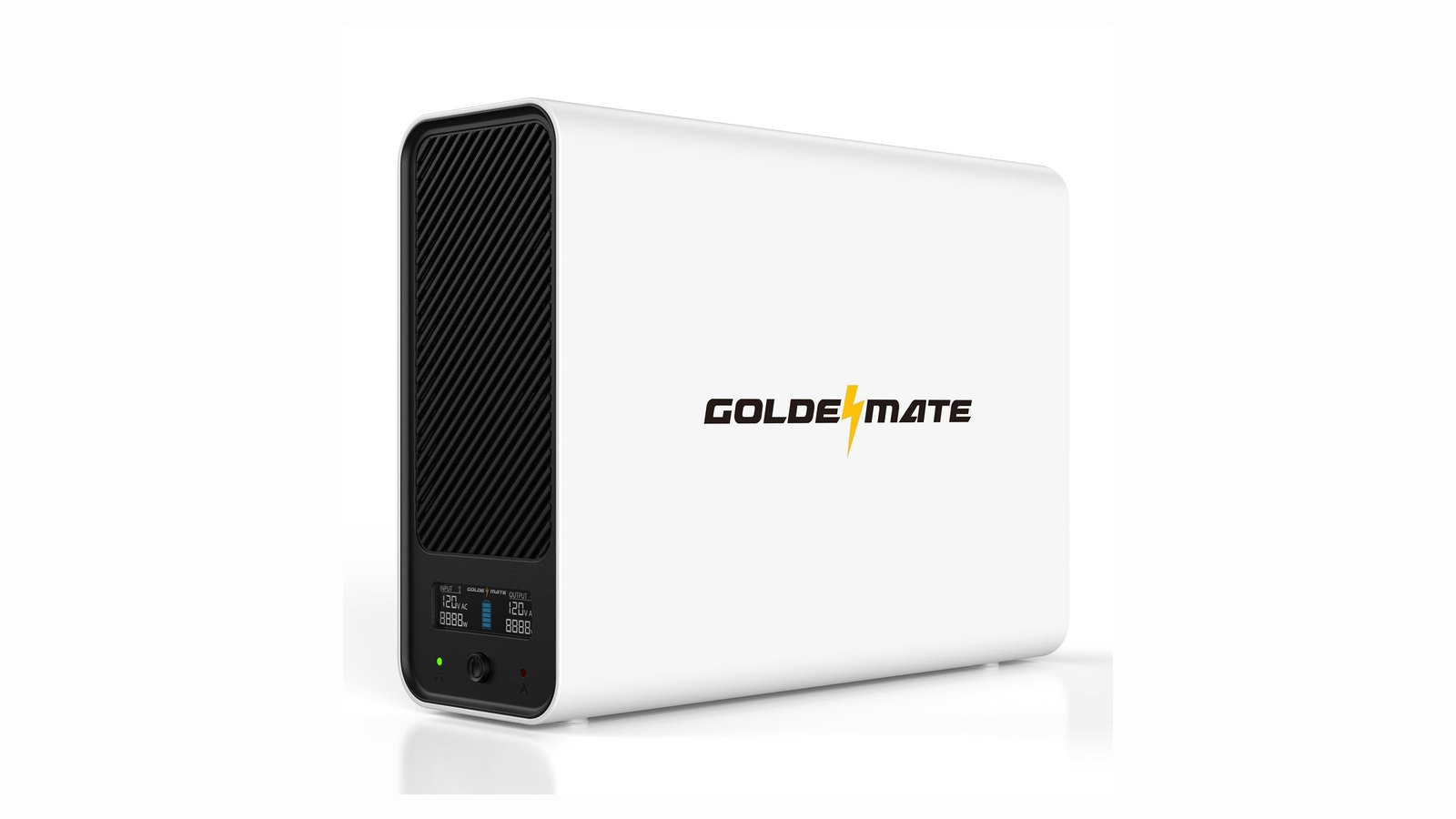
A white box on your desk that keeps the lights on when the grid does not. That is the whole proposition here, and it is worth being precise about what this particular box does and does not do.
The GOLDENMATE 1000VA/800W is a tower-form uninterruptible power supply built around a lithium iron phosphate battery rather than the lead-acid cell most UPS units still ship with. It puts out pure sine wave power, carries eight NEMA outlets, and the manufacturer’s listing claims a runtime of up to 30 minutes at a 400 W load. It also, notably, has no USB charging ports and no communication port — the two features that would let it talk to a NAS or top up a phone.
We read the manufacturer’s own listing and the product graphics published with it closely, because they do not fully agree with each other. Two numbers conflict: the number of battery charge cycles, and the weight of the unit.
An honest note on the evidence behind this review
We did not perform hands-on testing. Nobody here has plugged this UPS into a wall, cut the power to it, or measured how long it actually ran a desktop. Everything in this article comes from the manufacturer listing record and the product images published with that listing.
We could not extract individual buyer review text, so we quote no buyers. We do report the themes that Amazon’s own generated summary of the customer reviews surfaced, and we attribute them to that summary rather than to us. The aggregate rating on this listing at the time of writing is 4.4 out of 5 stars from 1,595 global ratings — a platform aggregate of buyer submissions, not our editorial score.
Everything a manufacturer states is stated here as a manufacturer claim. Where the listing’s own documents contradict each other, we say so rather than picking the convenient number.
What the listing’s specification rows actually say
- Brand and maker: GOLDENMATE
- Model number: UPS 1000VA Pro/800W
- Capacity: 1000VA, 800W, 6.67 A, 120 volts in and out
- Outlets: eight, NEMA 5-15P, Type B three-pin North American plug
- Output waveform: pure sine wave
- Battery: lithium iron phosphate (LiFePO4), 25.6 V 9 Ah, listed as 230.4 Wh
- Runtime: listed as 30 minutes, and more precisely as ≤30 min at 400 W and 25 °C
- Charging time: 10 hours
- Battery average life: 10 years
- Dimensions: 12.99”D x 4.13”W x 9.84”H, tower form factor
- Enclosure material: listed as electronic components and battery
- Warranty: 2 years
- Standards recorded in the specification table: UL1642, UL1973, UL1778, FCC, TUV
- Rating: 4.4 out of 5 stars from 1,595 global ratings (Amazon aggregate)
- Best Sellers Rank: #9 in Computer Uninterruptible Power Supply Units at the time of writing — a platform position that moves daily
The specification graphic, and where it disagrees
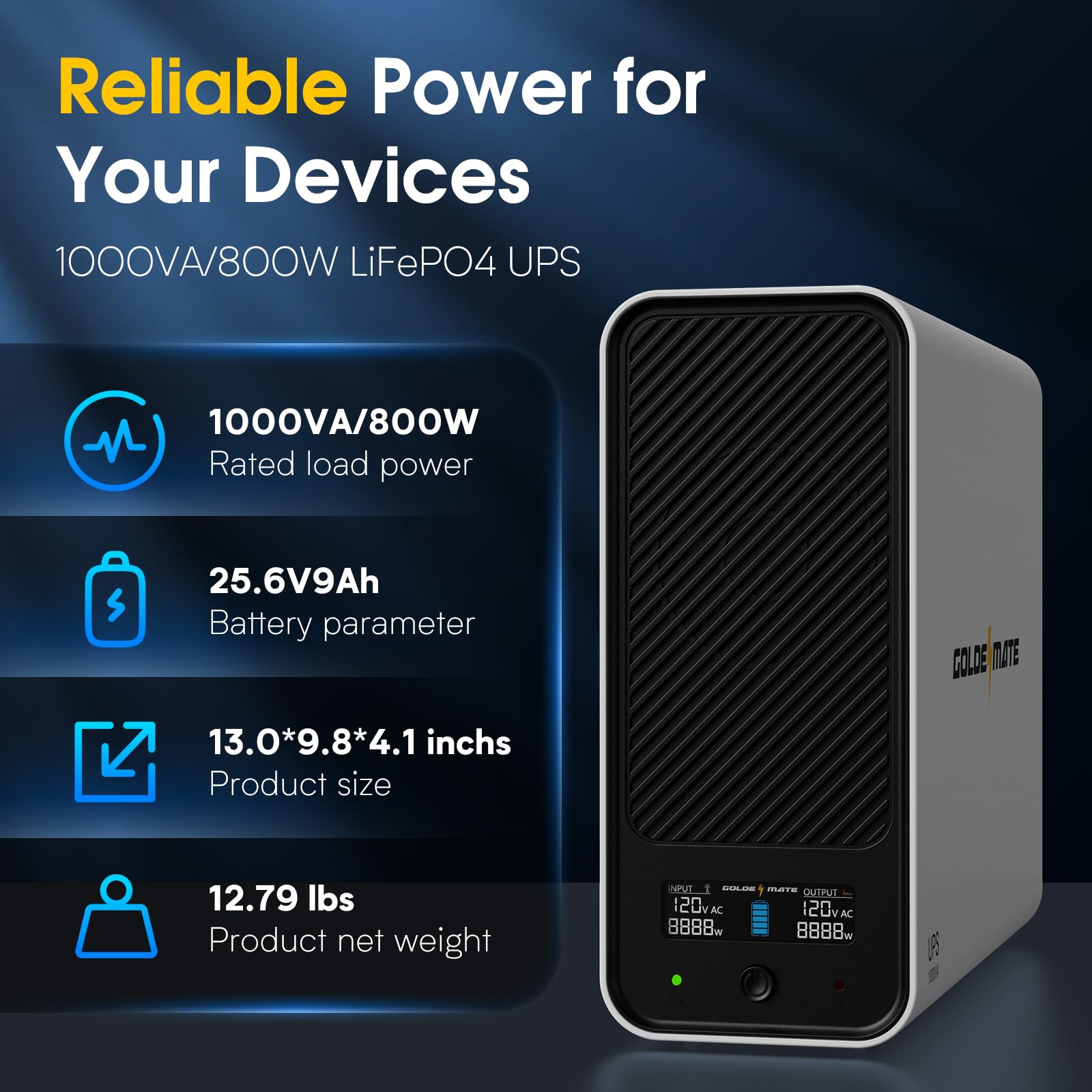
This is the manufacturer’s own summary graphic for this model, and it is the most useful single image on the listing. It confirms the core numbers we quoted: 1000VA/800W rated load power, and a 25.6 V 9 Ah battery parameter, which multiplies out to the 230.4 Wh the specification table records.
It is also where the first disagreement shows up. The graphic prints a product size of 13.0 × 9.8 × 4.1 inches. The specification table records 12.99”D x 4.13”W x 9.84”H. Those are the same three numbers in a different order, so we treat them as consistent.
Weight does not reconcile. The graphic states 12.79 lbs product net weight. The specification table carries two separate weight entries — 5.6 kg under item weight, and 12.13 pounds under product weight. Three figures, none of them equal to each other. If the shipping weight matters to your shelf, this is the number to confirm with the seller rather than to plan around.
What this unit does not have
Three of the rows in this listing’s specification table are marked with a cross, and they are worth reading together because they define the product as much as the features do:
- AVR — no. Automatic voltage regulation is not fitted. The listing describes the unit as continuously monitoring battery voltage and reacting to outages, high and low voltage, drops, shocks, pulses, fluctuations and surges, which is surge and backup protection rather than the steady-voltage conditioning that AVR provides.
- Communication port — no. There is no data connection to a computer or NAS, so no automatic safe shutdown on outage.
- USB charging ports — no. Nothing to plug a phone into.
For most home uses none of that matters. If your plan involves a NAS that needs to shut itself down cleanly, or a phone that needs charging during a long outage, this is the wrong unit — and GOLDENMATE’s 1500VA wall-mount model is the one that adds both.
The display and the controls
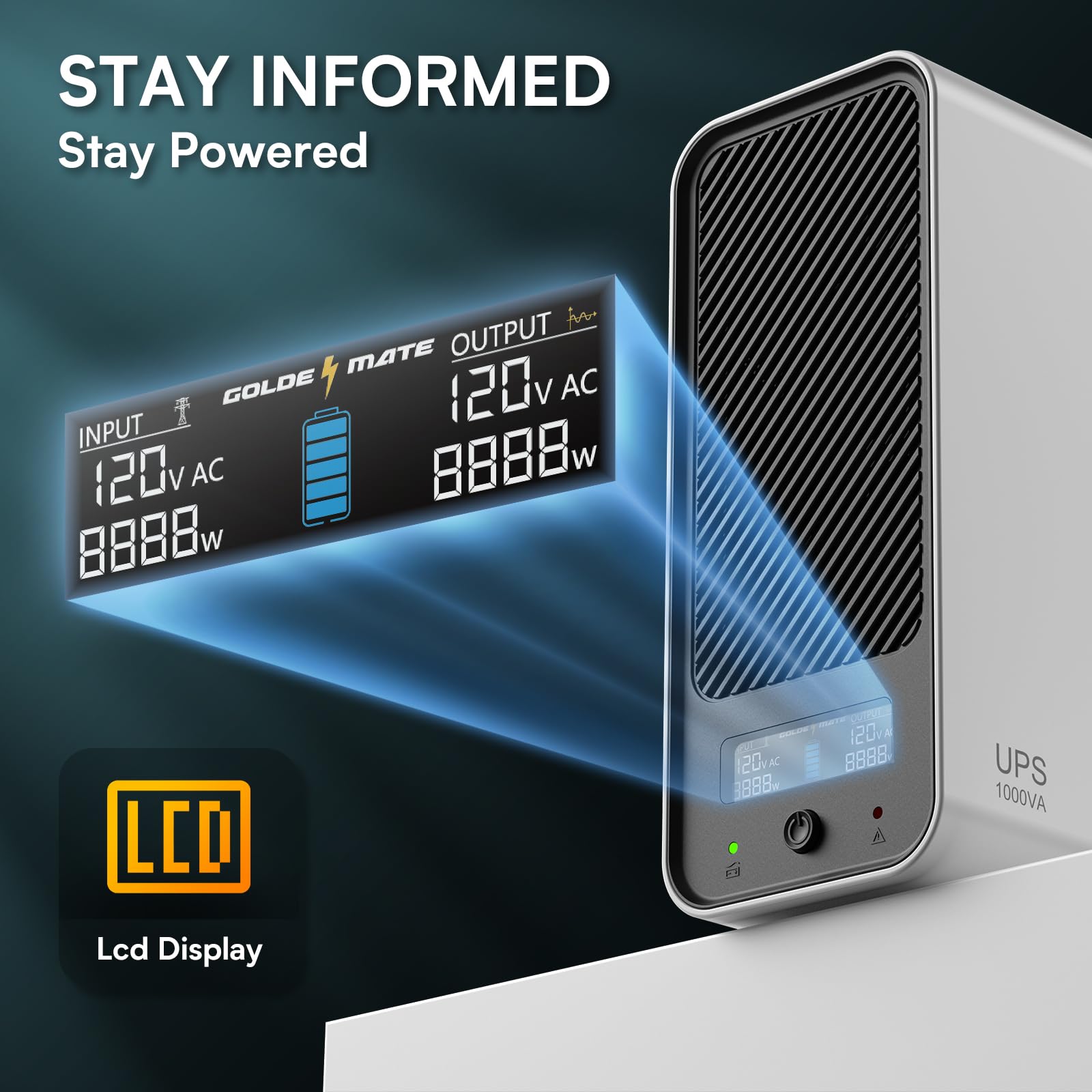
The front panel carries a small LCD that reports input and output state, and the manufacturer describes it as cutting charging and discharging if limits are exceeded, which it presents as protection against overloading and overheating as well as a way of extending service life.
The one control below the display is a multifunction button. The manufacturer’s instructions are specific: a long press of three seconds powers the system on, a long press of five seconds powers it off, and a single touch mutes the buzzer that sounds when mains power goes abnormal. The buzzer alarm frequency is set in the manual rather than fixed.
Runtime, charging, and the cycle-life conflict
The runtime figure is the one number a buyer is most likely to hold onto, so it is worth reading exactly. The listing records battery runtime as ≤30 min at 400 W and 25 °C. That is a 30-minute claim at a 400 W draw on an 800W-rated unit — half the unit’s rated capacity, which is a conservative way to publish it.
Charging takes 10 hours, and battery average life is listed as 10 years.
The cycle-life claim is where the listing’s text and the listing’s graphics disagree, and the disagreement is large. The feature bullet says the battery pack delivers a lifespan of over 10 years and more than 5,000 charge cycles. The product graphic published with the same listing prints 3000+ cycle life. Same product, same listing, a 67% difference in the headline endurance number.
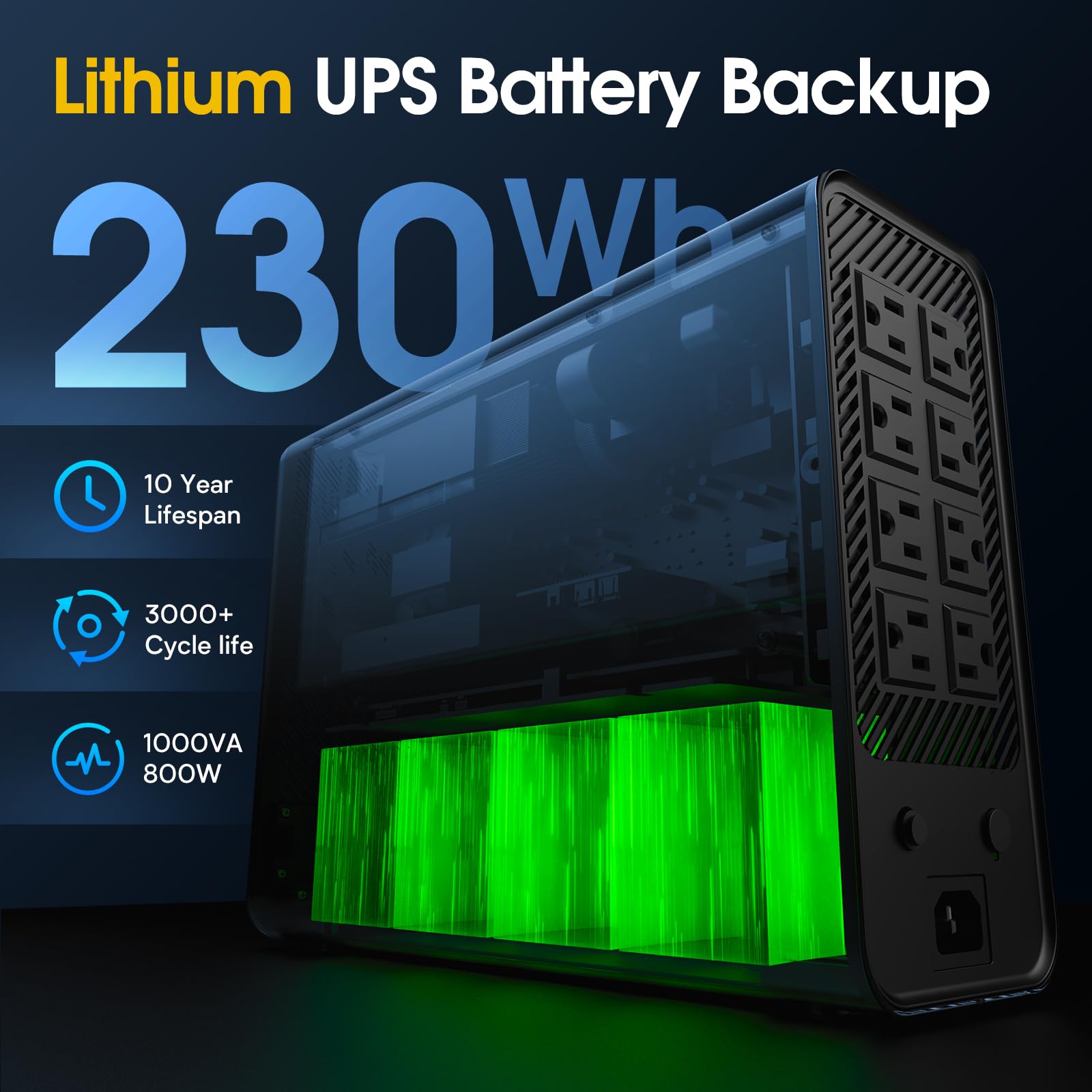
We cannot tell you which figure is current. What we can tell you is that the more conservative of the two is the one printed on the image a buyer sees while shopping, and that a cell rated for a decade of service life is not the same thing as a cell rated for 5,000 cycles. Treat 3,000+ as the number to plan around and ask the manufacturer directly if the difference matters to you.
The manufacturer also claims a total cost of ownership more than 40% lower than a comparable lead-acid solution, on the basis that the battery is not replaced on a multi-year schedule. That is a manufacturer cost comparison against a category average, and we have not independently verified the lead-acid replacement costs it assumes.
Eight outlets, surge protection, and the physical build
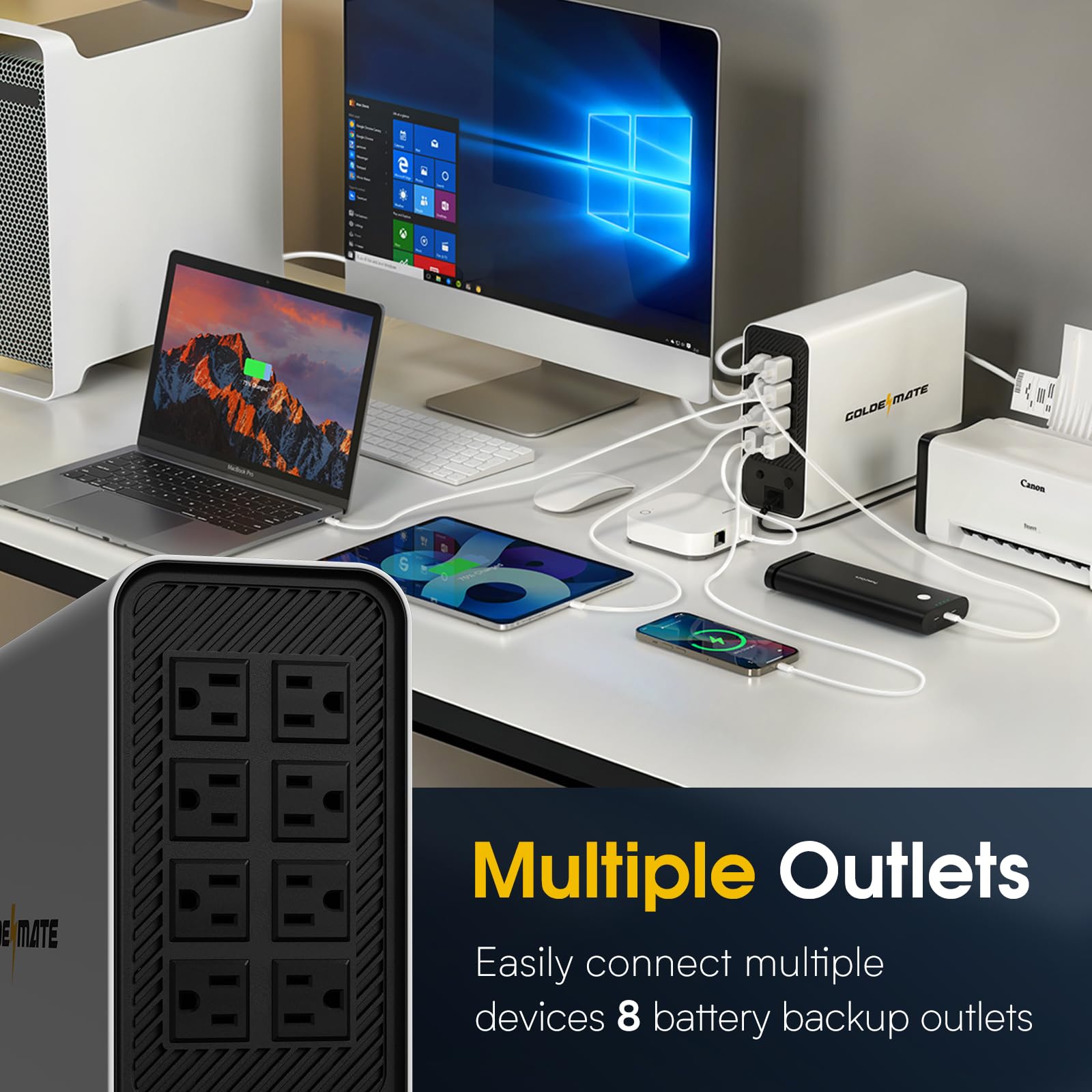
Eight NEMA 5-15P outlets carry both surge protection and battery backup, and the package includes an AC power cord. The unit ships with a built-in battery management system and PP45 terminals for the battery connections.
Physically it is a plain white tower: 12.99 inches deep, 4.13 inches wide, 9.84 inches tall. That footprint is narrow enough to stand beside a monitor rather than sit under a desk, which is the single most useful thing to know about it if you have limited shelf space.
Cooling is handled by an updated fan that the manufacturer rates below 50 dB, and that runs only when the battery management system detects heavy battery usage. In normal battery mode it is not the dominant noise in a room.
What the protection claims cover
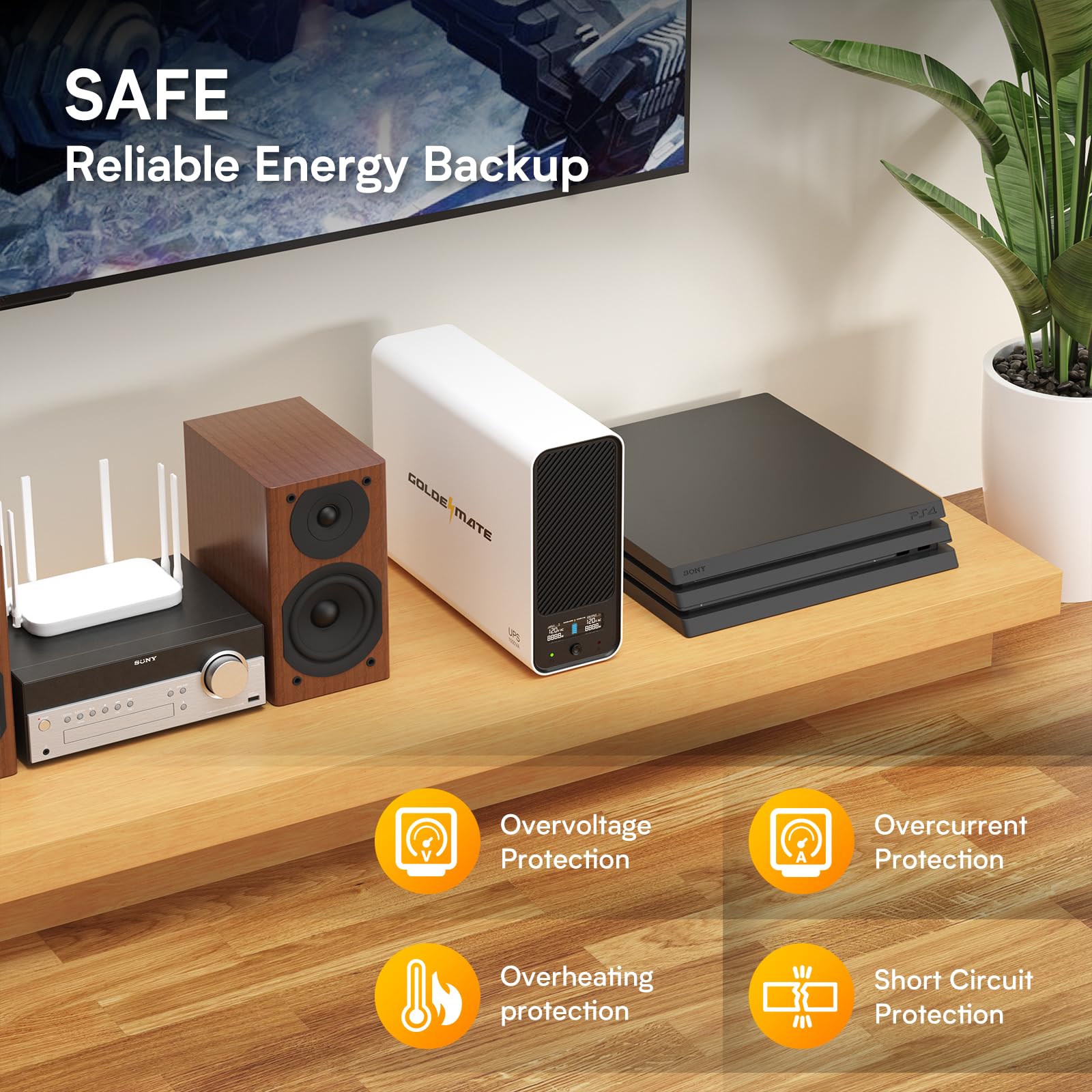
The four protections the manufacturer names on this graphic are overvoltage, overcurrent, overheating and short circuit. The feature bullet adds the list of electrical disturbances the unit is built to address: outages, high and low mains voltage, voltage drops, shocks, high-voltage pulses, fluctuations and surges.
Two operating notes from the manufacturer are worth knowing before you install it. The first is that the unit accepts 90–140 V AC input, which is wider than a nominal 110 V household supply, but you should still confirm your outlet voltage. The second is a specific generator warning: generator output may not satisfy the input requirements for voltage, frequency, waveform or grounding, in which case the unit can stay in battery mode and will not recharge. If you plan to run this on generator power, that is a limitation to check with the manufacturer.
The other manufacturer claims
The listing also claims a cooling system integrated with the battery management system, the safety certifications named in the specification table, “double anomaly protection” from the chip technology, and maintenance-free operation for up to 10 years. It states that the intelligent LCD panel’s automatic safety mechanism halts charging and discharging if limits are exceeded.
The graphic for the cooling system is the manufacturer’s own illustration of the fan airflow:

What the buyer reviews say, in Amazon’s own summary
We quote no individual buyer. What we can report is the set of themes Amazon’s generated review summary for this listing surfaced, and it is worth reading as a mixed picture rather than a verdict.
The summary reports that buyers find the unit reliable, with one mentioning it kept a PC running without a hiccup, and that they find it easy to set up as a plug-and-play device. On battery life it reports positive feedback, including a claim of lasting up to three hours on an average 100 W draw, and one buyer noting the LiFePO4 chemistry should last at least ten years. On noise it reports that the unit is quiet in operation while some buyers mention a high-frequency humming. On value it reports that some buyers consider it worth the price and others do not.
Two threads are worth flagging. The summary reports that power protection is mixed, with some buyers reporting the unit does not protect against surges. And on durability it reports that while some units lasted over 17 hours, others lasted only two months. A spread like that is a manufacturing-consistency signal, and it is the kind of thing that only aggregate review text can tell you — which is exactly why we are passing on the summary’s findings rather than a single verdict.
Pros and cons
Pros
- ✔ 230Wh lithium iron phosphate battery rather than a lead-acid cell, with a listed 10-year average service life
- ✔ Pure sine wave output, which is what sensitive electronics actually want
- ✔ Eight NEMA outlets, each carrying both surge protection and battery backup
- ✔ Narrow tower footprint that stands beside a monitor instead of under a desk
- ✔ LCD panel with a defined single-button control for on, off and buzzer mute
- ✔ Specification table names specific standards: UL1642, UL1973, UL1778, FCC and TUV
- ✔ Two-year warranty as recorded on the listing
Cons
- ✘ No communication port, so there is no automatic safe shutdown for a NAS or PC
- ✘ No USB charging ports
- ✘ No AVR, so voltage conditioning beyond surge protection is not part of the design
- ✘ The listing contradicts itself on charge cycles: more than 5,000 in the bullet, 3000+ in the graphic
- ✘ The listing carries three different weights for the same unit
- ✘ The listing’s own runtime figure is a half-load 30-minute number, not a light-load one
- ✘ Generator power may not be recognised as valid AC input, and the battery will not recharge on it
View the GOLDENMATE 1000VA/800W Lithium UPS on Amazon
Prices and availability change daily on Amazon — check the listing for the current offer.
Who should buy it
Buy it if you want a compact backup for a desktop, a monitor, a router and a NAS drive, and you are content to shut the NAS down yourself when the power goes.
Buy it if a decade-long battery service life is the point. Moving from lead-acid to lithium iron phosphate is the reason this unit exists, and the listing’s own specification rows carry a 10-year battery average life.
Buy it if the tower form factor matters to you. At 4.13 inches wide it fits beside a monitor in a way a wide, flat UPS does not.
Buy it if you want pure sine wave output on the record rather than in the marketing copy.
Who should skip it
Skip it if you need automatic safe shutdown. Without a communication port, your NAS or PC will not be told that the power has failed.
Skip it if you want to charge a phone or tablet from the unit during an outage. There are no USB ports.
Skip it if you need AVR. This unit is surge protection plus battery backup, not a voltage regulator.
Skip it if the 30-minute runtime figure is the deciding number for you. It is published at a 400 W load, and anything lighter runs longer — but nothing in the listing gives you a light-load figure, so we cannot give you one either.
And skip it if you intend to run it on generator output without checking with the manufacturer first, because the unit may sit in battery mode and not recharge.
Frequently Asked Questions
How long does the battery last?
The listing records a runtime of up to 30 minutes, stated more precisely as 30 minutes or less at a 400 W load and 25 °C. That is at half the unit’s 800 W rating, so lighter loads run longer. Charging takes 10 hours.
How many devices can it power?
Eight NEMA 5-15P outlets, each with both surge protection and battery backup. The unit is rated 800 W continuous, and the runtime figure is published at a 400 W draw, so eight outlets does not mean eight full-load devices.
Does it work with a NAS?
It will keep a NAS running during an outage, but it will not talk to it. The specification table marks the communication port as absent, so there is no automatic safe shutdown signal.
Can I charge a phone from it?
No. The specification table marks USB charging ports as absent on this model.
Is the battery really good for ten years?
The listing records a battery average life of 10 years, and the manufacturer states a lifespan of over 10 years with more than 5,000 charge cycles. The product graphic published on the same listing prints 3000+ cycle life. The claim of a decade of service is consistent across both; the cycle count is not. We would plan on the lower figure.
Is it a surge protector as well as a UPS?
Yes. The eight outlets carry surge protection in addition to battery backup, and the listed protections cover overvoltage, overcurrent, overheating and short circuit.
Does it work with a generator?
The manufacturer warns that generator output may not meet the unit’s input requirements for voltage, frequency, waveform or grounding, and that if it is not recognised as valid AC input the unit will remain in battery mode and the battery will not recharge. Check with the manufacturer before relying on it for that.
What does the unit weigh?
The listing does not agree with itself. The product graphic states 12.79 lbs, the specification table records 5.6 kg under item weight and 12.13 pounds under product weight. Confirm the figure with the seller if it matters to you.
The bottom line
This is a well-specified, honestly-constructed small UPS for the job most people actually need one for: keeping a computer, a monitor and a network box alive long enough to save work and shut down cleanly. The lithium iron phosphate battery is the reason to look here rather than at a lead-acid unit, the pure sine wave output is right for anything with a power supply in it, and the footprint is genuinely small.
What it does not have is worth as much attention as what it does. No communication port, no USB charging, no AVR. That is a coherent design for a single-purpose backup box, but it means the GOLDENMATE 1500VA wall-mount is the one to look at if your setup includes a NAS that should shut itself down.
And the listing itself needs a caveat. Two numbers on this page disagree with the page’s own graphics: 5,000-plus charge cycles in the text against 3,000-plus on the image, and three different weights for one unit. Those are not reasons to avoid the product, but they are reasons to keep the manufacturer’s figures as claims rather than measurements.
Buy it for the battery chemistry and the pure sine wave output. Confirm the weight with the seller, and plan around the lower cycle count.
Browse the GOLDENMATE brand store on Amazon
Prices and availability change daily on Amazon — check the listing for the current offer.
Sources cited in this article
- Amazon — manufacturer listing for the GOLDENMATE 1000VA/800W Lithium UPS Battery Backup & Surge Protector, White, including the full feature-bullet set, the listing specification table, the generated summary of customer reviews, and the aggregate rating of 4.4 out of 5 stars from 1,595 global ratings (accessed November 2026)
- The manufacturer’s own product graphics published with that listing, including the Reliable Power for Your Devices, Stay Informed Stay Powered, Multiple Outlets, Lithium UPS Battery Backup, SAFE Reliable Energy Backup and Efficient Cooling images reproduced in this article
- Product listing Best Sellers Rank in Computer Uninterruptible Power Supply Units, as displayed on the listing at the time of writing
This article contains affiliate links. When you buy through them, we may receive a commission from the brand or platform at no additional cost to you. Our editorial process is independent of affiliate relationships — see our Affiliate Disclosure and Our Method.